The Kitanesque Guide to Y2K Fashion (and How to Wear It Now)

UK delivery from this site · prices in GBP · Outside the UK? Find our pieces on eBay and Vestiaire Collective, which ship internationally.
Someone will pick up a pair of low-rise flares, hold them at arm’s length, and ask me whether they’re going to look brilliant or ridiculous.
Both. It depends entirely on the waist measurement, and I’ll come back to that.
This is the guide I’d hand across a counter if I had one. What the era actually was, the eight things I keep finding, how the sizing works, and how to wear any of it in 2026 without it reading as fancy dress.
What Y2K actually was
Roughly 1998 to 2006. Fashion had decided the future would be shiny, small and cut very low on the hip, and it committed. Baby tees. Micro shorts.
Bootcut flares that dragged along the pavement until the hems went to fringe. Denim minis, slip dresses over t-shirts, and pockets embellished to the point you could pick someone out across a car park by their arse.
Then everybody spent about fifteen years pretending it hadn’t happened.
That’s the reason it’s worth buying now. The clothes that got binned for being embarrassing are the ones nobody kept, so what’s left is genuinely scarce. There’s a pattern there I think about a lot — the thing called used-up, thrown out, and then wanted again about twenty years later.
Two things separate it from the 90s, which people muddle it with constantly. Rise: 90s denim sat at or near the waist, Y2K sat on the hip and sometimes a fair way below it. And decoration: the 90s were plain, Y2K was embroidered, studded, crystal-set, printed, all at once. If the pocket is doing something, it’s Y2K.
The eight things I actually stock
I sell what I can find and verify rather than what a trend piece says the decade was. As I write this there are 124 pieces tagged Y2K on the site and the median price is £25. These are the shapes that keep turning up.
1. Low-rise flares and bootcuts
The spine of the whole thing. A bootcut opens gently from the knee, a flare opens wider, and both were cut with a rise of seven to nine inches — when the label says low rise it isn’t exaggerating.
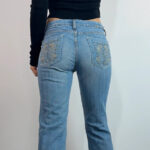
The embellished ones are the prize. This Miss Me pair with embroidered, embellished pockets (W26, £50) is about as pure as the era gets; this distressed Rock Revival bootcut is the version you’d actually wear on a Tuesday. All the flares are here — biggest single category I hold.

2. Denim micro shorts and hotpants
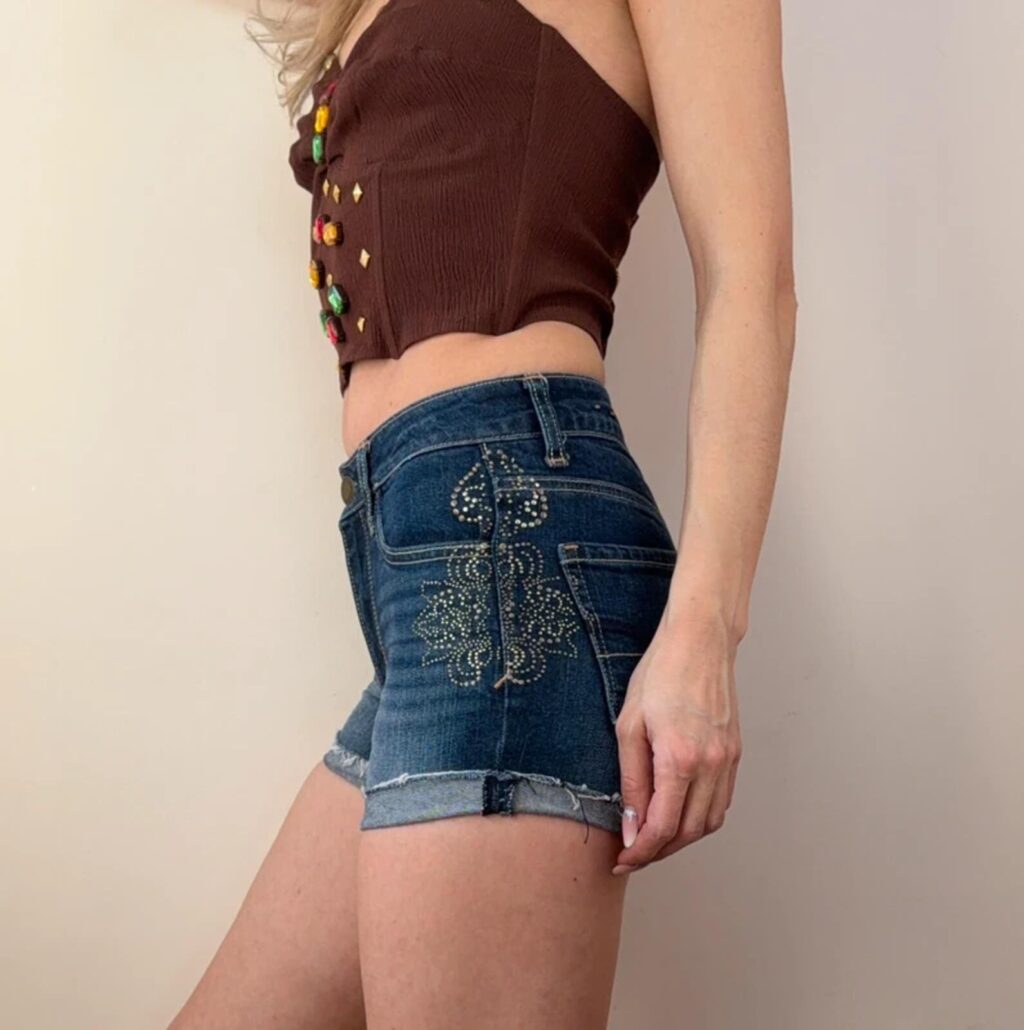
Cut-off, low, usually studded, and shorter than you remember them being. American Eagle, Miss Sixty and Diesel turned them out by the thousand. These embellished American Eagle micro shorts (W25, £17.50) and these Miss Sixty cutoffs (£17.90) are exactly the thing — cheap, worn soft, and impossible to buy new in that cut. Rest of them in denim shorts.
3. Cropped and fitted denim jackets
Short in the body, nipped at the waist, nearly always a lighter wash than the jeans they went with. The embroidered and rhinestoned ones are rare. This customised Miss Sixty (£90) is one I did myself. This DieselStyleLab (£95) came from Diesel’s experimental StyleLab line, launched in 1998 and since closed, and is worth knowing about. Both sit in denim jackets.

4. Denim mini skirts
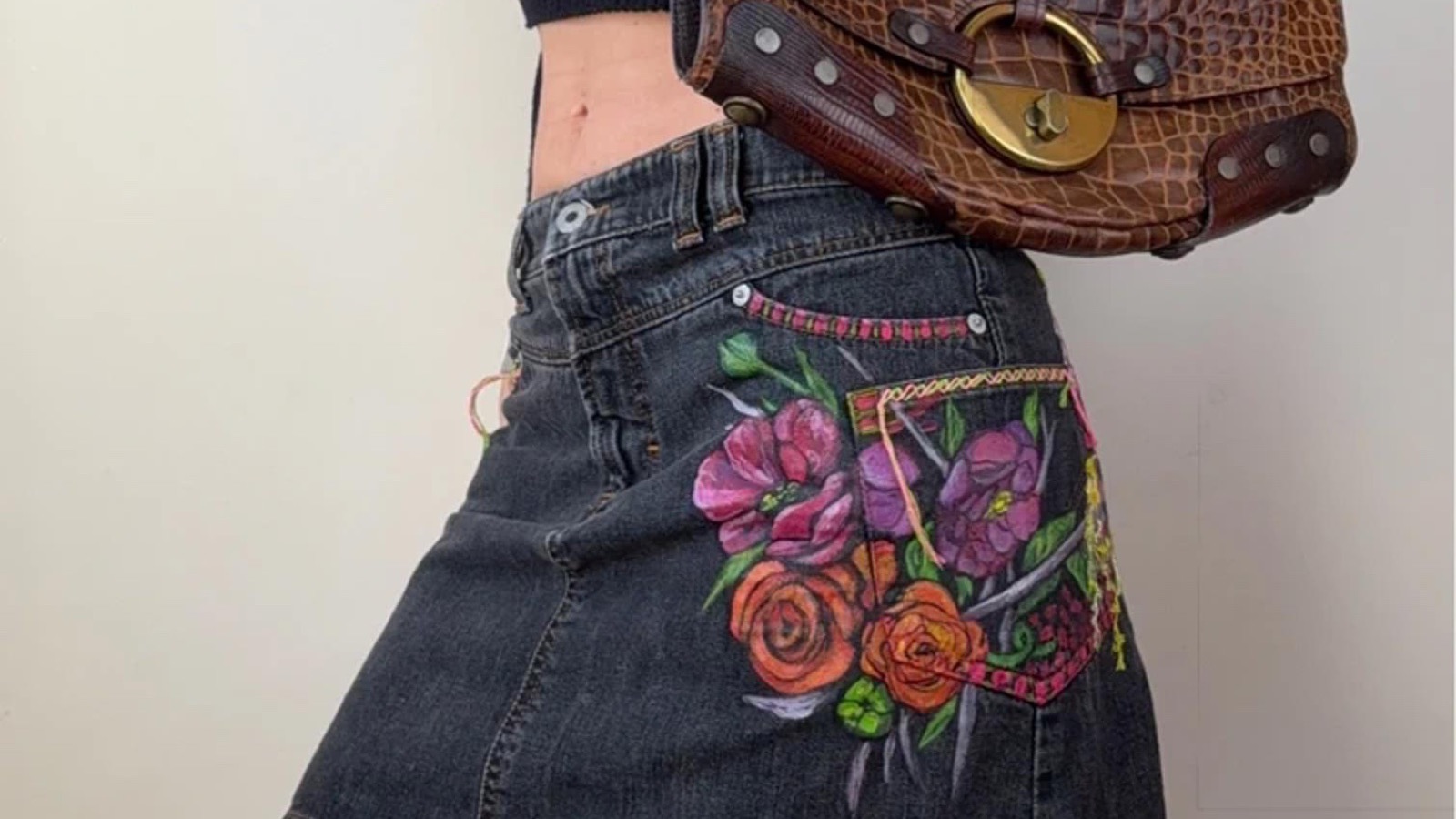
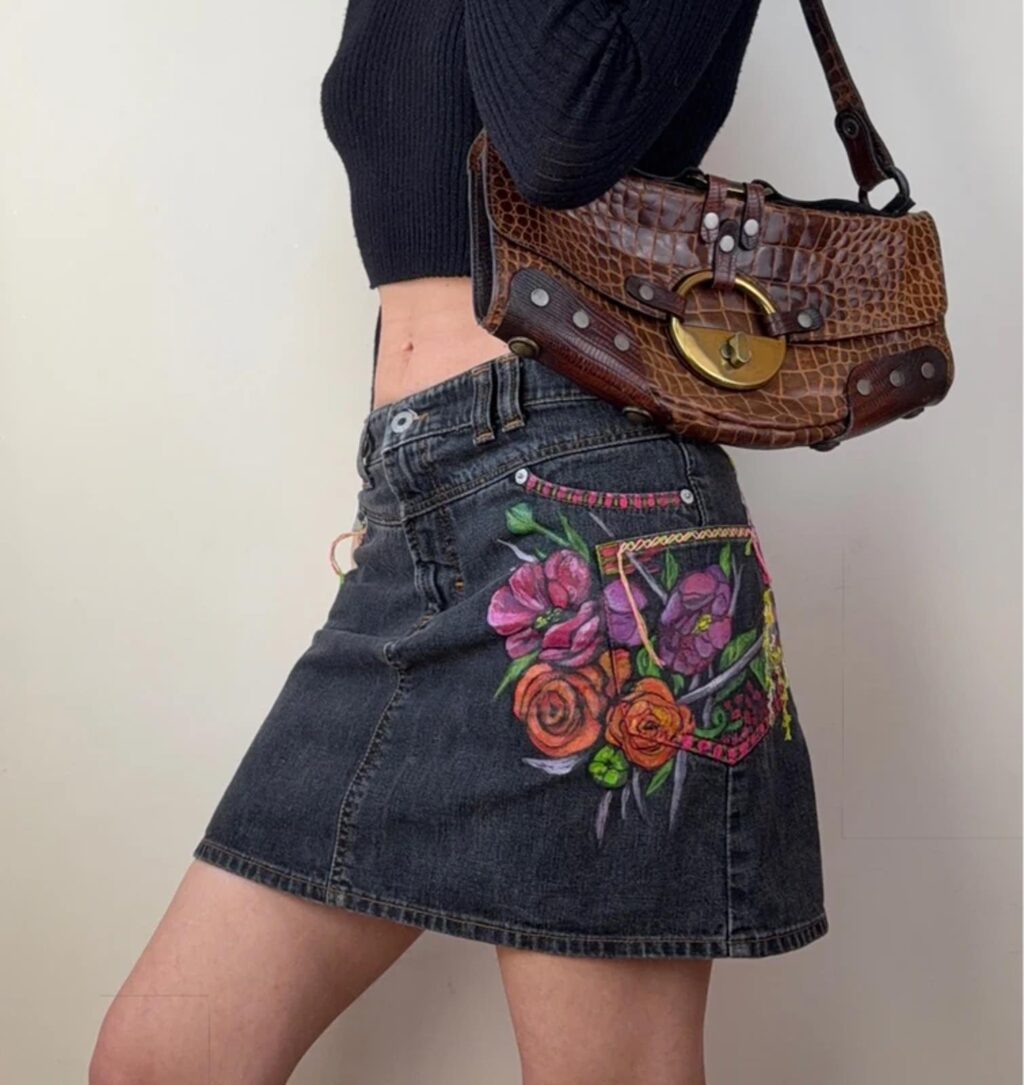
Low, short, ruffle hem or embroidery, occasionally both. This Love Moschino ruffled mini (£25) is the affordable end and this hand-painted Dolce & Gabbana (£95) is the archive end. Not much in between, because the decade didn’t do subtle. More in mini skirts.
5. Baby tees
Fitted, cropped, logo or graphic across the chest, and cut a size smaller than whatever the label claims. This pink Guess (UK 14, £17) and this black Kappa Italy (£19.50) are the shape to look for. The rest are in short-sleeve t-shirts.

6. Slip dresses and bodycon minis
The going-out dress. Strappy, short, usually black, and worn home with somebody’s cardigan over it. This black Guess bodycon (£14.45) is the classic version and it lives in mini dresses with the others.

7. Racerback tanks and vests
Ribbed, fitted, layered two at a time because one was never enough. The graphic ones are the hunt — Diesel made a blue and white racerback that I’ve had come through more than once and it goes within days. They’re in tank tops and they’re the cheapest way into the decade.
8. Anything embroidered, studded or crystal-set
Not really a garment type. It’s the thread running through all seven above.
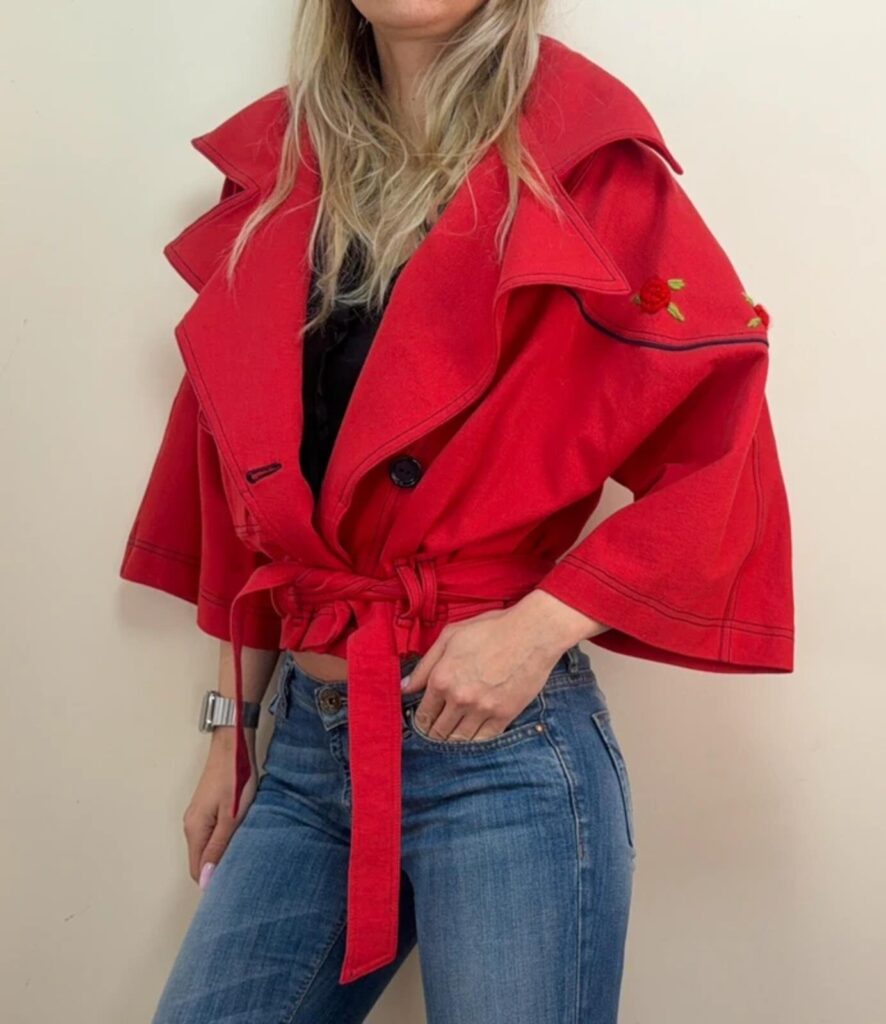
Decoration on denim was the era’s entire identity, and it’s the one part fast fashion can’t fake convincingly, because it was done by hand or on machines that have since been scrapped. So: if two pairs of flares are the same size and one has embroidered pockets, take that one. It’ll hold value. The plain one won’t.

Sizing — the honest bit
This is where Y2K goes wrong for people, so I’ll be blunt about it.
A low-rise jean is measured at the hip. Not the waist. A Miss Sixty marked W28 is not a 28-inch waist — it’s a 28-inch measurement taken wherever that jean happens to sit, and on a seven-inch rise that’s a long way below your natural waist.
Hold it against a modern high-rise 28 and you’re two dress sizes out. I’ve written a whole piece on why Miss Sixty sizing in particular is a law unto itself, if that’s the brand you’re after.
Which is why I don’t trust labels and you shouldn’t either.
Every pair of jeans, every pair of shorts, every skirt on this site has flat measurements in the listing — waist, hip, rise, inseam — taken by me, with a tape, on a table.
Match those against something you already own and love. The size guide covers how to take your own, plus UK/EU/US conversions and why vintage labels can run small.
Two other things worth knowing. Most of what survives from this era is a UK 8 to 10, because that’s what was made and what got kept, with a thinner run of 6s and a decent amount of 12 to 16 from the American labels, which sized more generously.
And stretch ages: a 2003 stretch denim has often lost some of its recovery, so I say in the listing whether a pair still snaps back or has gone relaxed.
How to wear it now
One Y2K piece at a time. That’s the whole trick.
Flares with a plain fitted top and a shoe that isn’t a platform. Baby tee under a blazer. Denim mini with tights and boots instead of bare legs and a halter neck. The slip dress over a t-shirt still works, which surprises people — that was the era’s own styling and it’s aged better than most of what it did.
What tips it into costume is stacking. Flares and baby tee and cropped jacket and tinted sunglasses in one go, and you’ve gone to a themed party. Wear one piece like you’ve had it for years. Somebody did.
The labels
What keeps coming through, and what each one is for. Miss Sixty for Italian low-rise with something going on. Miss Me for the embellished American bootcut. Diesel, DieselStyleLab especially, for strange washes and good jackets. Dolce & Gabbana for embroidered denim at the top of the price list.
American Eagle and Guess for the cheap, correct, everyday stuff. True Religion, Silver, Rock Revival and WallFlower for bootcuts with a bit of character. Full list on the designers page — a label only gets its own page once I hold enough of it to be worth the click.
How to tell the real thing from a reproduction
Every fast-fashion label reissues Y2K now, and the reissues are why people try the era once and decide it isn’t for them. Four tells, all of which I check before anything goes up.
The label. A 2000s label is usually woven, and the country often tells you the era: older Miss Sixty and Diesel often say Italy, older True Religion and Miss Me the USA.
Made in Italy in 2004 and the same name printed in Bangladesh in 2024 are not the same object. A website printed on the care label usually means a newer pair.
The denim. Original low-rise stretch was heavier than what’s sold now: firm cloth with a bit of elastane, not the thin high-stretch jersey that gets called denim today. Hold it to the light.
If the light comes through, it’s new. Old cloth also fades in a particular way — whiskering at the hip, pale down the front of the thigh — because somebody wore it for years rather than a machine distressing it in an afternoon.
The decoration. Real 2000s embroidery is dense, slightly raised, usually backed with a cloth on the inside. Crystals were set individually and some will be gone, which I photograph and say. A reproduction has flat sparse embroidery and heat-pressed studs that have all survived because nobody has ever sat down in the jeans. Missing stones are, strangely, a good sign.
Rise and hardware. Get a tape on it. A real low-rise pair measures seven to eight and a half inches from crotch seam to waistband, and the waistband is contoured rather than straight, so it doesn’t gape behind.
Reissues sit higher, because a true low rise doesn’t sell to a modern customer without a warning label, and their waistbands run straight. Zips on the originals we handle are metal, YKK or the house’s own, and buttons are shanked.
Looking after it
Old stretch denim has one enemy and it’s heat.
Wash cold, inside out, never tumble dry. The elastane in a 2004 pair has already done twenty years and a hot dryer finishes it in a single cycle. Hang by the waistband so the weight pulls the leg straight rather than dragging the seat out of shape.
Anything with crystals or studs goes in a mesh bag or gets done by hand — the stones are glued as well as set, and it’s the glue that goes first.
Embroidered pieces, inside out, and never iron the front. Baby tees and ribbed tanks want cold water and a flat dry; the ribbing is what holds the shape and it relaxes permanently if you stretch it while it’s wet.
None of this is hard. It’s just the opposite of how most people treat clothes now, which is precisely why the originals lasted long enough to reach me.
Questions people ask
Will a UK 8 from 2003 fit a UK 8 now?
Usually not. Expect it to fit like a modern 6, and on low-rise denim the label size is close to meaningless anyway. Use the flat measurements in the listing and compare them to something in your wardrobe. The size guide explains how to measure.
What condition are these in?
Described honestly, every time. I photograph flaws and list them, and I say whether the stretch has relaxed, whether embroidery has lost stones, whether a hem’s been taken up by a previous owner.
Most Y2K denim was worn hard and it shows in the good way — softened, faded at the thigh. Anything with damage past that is priced for it and says so.
Can I return it if the fit is wrong?
Yes. Full terms and the cancellation form are on the shipping and returns page. Fit is far and away the most common reason with this era, which is why I go on about measurements.
How does delivery work?
Royal Mail Tracked or an InPost locker, UK-wide, free over £40. Options show at checkout and are explained on the shipping page. Everything here is one of a kind, so once it’s gone it’s gone.
Is Y2K the same as 90s?
No, and it’s the commonest mix-up I get. The 90s edit is higher-waisted, plainer, more grunge and minimal. Y2K is low, decorated, glossy. They sit next to each other on the site and I keep them apart deliberately.
If the witch in the first Journal post was the woman written off and then wanted back, Y2K is the decade that got the same treatment. The flares are still in the back of someone’s wardrobe.