Before the Witch: Isis, Hecate and the Druid Priestesses

UK delivery from this site · prices in GBP · Outside the UK? Find our pieces on eBay and Vestiaire Collective, which ship internationally.
Before anyone was burned for it, a woman who healed, foretold and knew which plant did what was not a witch. She was a priestess, an oracle, sometimes a goddess.
I said in the first post that this series would follow the witch from the temple to the pyre and back to the runway; this is the temple part, and it is shorter than you would think, because for a very long time nobody needed a word for her at all.

Isis, who brought a man back from the dead
In Egypt the goddess Isis owned magic, healing and wisdom outright. Her defining story is the one where her husband Osiris is killed and cut to pieces, and she gathers him, reassembles him and brings him back to life — by magic, not by asking a male god to do it for her.
The thesis, drawing on Geraldine Pinch’s standard book on Egyptian magic, reads that myth as the clearest early statement that magical power could be feminine and central rather than marginal.
Isis was not a figure at the edge of the culture; she was carved in stone and put in temples, and one of those statues, from about 570 BC, is still in the Egyptian Museum in Cairo.
Here is why that matters to a shop that sells old clothes, and I mean it literally rather than as a nice thought. What Isis does — takes something discarded and broken and makes it whole again, and is honoured for it — is the entire business I am in.

A 1990s Dolce & Gabbana knit that someone gave up on, pearl buttons intact, comes to me, gets photographed properly, measured flat, described honestly, and goes out to someone who will wear it for another decade. That is not resurrection, but it is the same instinct, and I would rather name it after a goddess than a recycling target.
Hecate, who lived at the crossroads
The Greeks gave the night to Hecate: magic, spells, ghosts, the moon, the places where three roads meet. She was drawn as a triple figure — three women in one body — and there is a marble hekataion from the first or second century that shows exactly that, three women back to back looking three ways at once.
The part of Hecate I keep coming back to is where she lived. Not in the city, not in the temple — at the boundary, between the living and the dead, and specifically as the protector of people the city had pushed out.

The thesis behind this series makes the point that she was the goddess of the excluded before she was anything else.
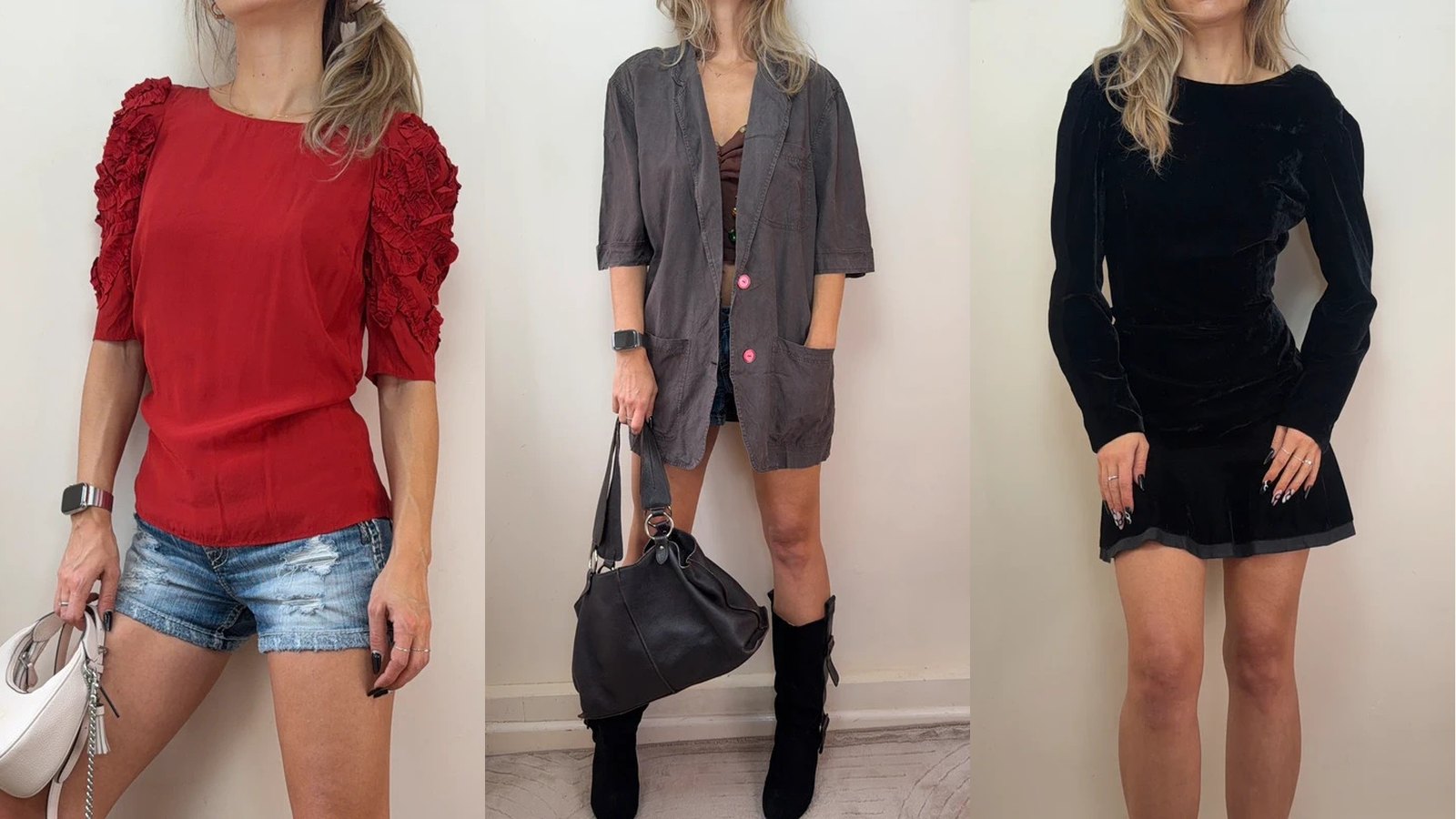
In the wardrobe the equivalent is obvious and I will say it plainly: the black slip dress, the fitted knit, the velvet, the lace — the pieces that look like her — are the ones that get bought by women who have decided not to dress for approval. It is the most consistent thing I see across the dresses that sell.
The druid priestesses, who read dreams and set bones
Later Roman and Irish writers describe Celtic women in religious office. The druidesses, as the thesis draws them, interpreted dreams, practised medicine with plants, ran rituals and told the future — a job description that, a thousand years later, would get a woman killed.
Barbara G. Walker, in her encyclopedia of myth, is direct about it: in pre-Christian Celtic societies women not only had access to druidic learning but were often venerated as priestesses of the goddesses. Venerated, in her telling. Not tolerated, not hidden. Paid attention to.
I find this the hardest of the three to hold onto, because it is the one that got erased most thoroughly. There are statues of Isis and of Hecate. Of the druidesses there is almost nothing physical, only the writing of people who came after and mostly disapproved.
Which is, again, the thing about secondhand clothes that I think about more than is probably healthy: a garment is often the only surviving evidence that a particular woman, with a particular waist measurement and a particular taste in green, existed and made choices.
The label inside a 90s dress is sometimes the only record. I would rather keep the record than not.
Then the word arrived
None of these women were called witches. The accusation existed, but it was not yet the one Europe would build.
What changed, the thesis argues, was the spread of monotheism and the hardening of patriarchy: magic, which had been a connection to nature and the sacred, was redefined as heresy, and the women who practised it were relabelled.
Over the following centuries Europe built a demonic image — the pact with the Devil, the sabbath, the spreading of disease, the manipulation of men — and by 1487 it had a manual. That manual is next week’s post, and I will not soften it.
The sequence is the point. The healer and the priestess did not become witches because they changed. They became witches because the people around them needed them to be, and wrote it down. The clothes did not change either.
Black was black, lace was lace, a long dress was a long dress; only what it was taken to mean shifted. Which is why I am comfortable selling a Victorian-shaped mourning dress and a 2000s Balenciaga slip on the same page under the same word: the meaning was always put on afterwards, by someone else.
Questions people ask
Do you sell actual antique or Victorian pieces?
Occasionally, and I say so exactly when I do. Most of what I hold is 1970s to 2000s, with the largest run in the vintage and Y2K edits. Anything older is listed with its era and its evidence — labels, construction, fabric — not a guess.
How do I know something will fit if the size label is old?
Every piece is measured flat and the measurements are in the listing; compare them to something you own rather than trusting the tag, because an older UK 8 can fit smaller than a modern 8. The size guide explains how to measure and what vintage sizing does.
What if it arrives and it is not for me?
Returns are accepted, and there is an online form for it; the terms and delivery options are on the shipping and returns page. Delivery is Royal Mail Tracked or an InPost locker, free over £40.
The full list of labels I hold, designers included, is on the designers page. Next week: the book that turned all of this into a crime.