
How to Tell if Vintage Designer Clothing Is Real
To tell if a vintage designer piece is real, check several things together: the brand label and the care tag behind it, the fabric content against the fabric itself, the stitching, the hardware, and any style or serial codes. They have to agree with each other and with the era the piece is from. No single detail proves it; a piece is real when everything adds up. Below is what that means for denim, bags, cashmere, leather and sheepskin, silk and designer labels, with photos of our own pieces.
Updated
On this page: What we look at Denim Bags Cashmere and knitwear Leather and sheepskin Silk Designer labels Questions
Every piece at Kitanesque is checked by hand before it is listed, by Andra, who trained in fashion design and has sold second-hand clothing on eBay since 2015. This page says what that check involves, what it does not, and what you get if we are wrong.
What we look at
- Labels. The brand label: weave, lettering, how it is sewn in, whether the design matches the era the piece claims to be from. The size and country labels next to it.
- Care and composition tags. Fabric content, wash symbols, country of manufacture, style or batch codes. A tag that is missing, printed badly or in the wrong language is the commonest giveaway.
- Fabric and lining. Weight, hand, how the material has aged. A 2003 pair of jeans should feel like one.
- Stitching and construction. Stitch density, seam finishing, bar tacks, pattern matching across seams. Factory work is even; copies rarely are.
- Hardware. Zips (maker, pull, tape), buttons, rivets, buckles: engravings, weight, how they are attached.
- Serial, date and style codes where the brand uses them, and whether they match the label and the tag. A US label carries an RN number: the registered identity of the company behind it, which we check against the FTC's public register, so “RN 93243” on a Diesel label has to come back as Diesel.
- Bags and leather goods. The heat stamp, patch or plate inside; the creed or code tag, and whether its style number matches the model; the engraving on zips, snaps and clasps; the edges, corners and handle fixings; the lining and how it is sewn in.
- Wear that matches the age. A vintage piece has lived. Wear in the wrong places, or none at all on a "1990s" piece, raises the question.
- The story. Too good to be true usually is: a price that makes no sense, or too many identical pieces about, is a reason to say no before anything else.
A piece that does not add up is not listed. There is no "probably genuine" category.
How we reach a conclusion
Looking is half of it. What we find on the piece is then compared with what we know, from three places:
- Our own record. More than 500 pieces measured and photographed, label included, and selling the same brands on eBay since 2015. For the labels we handle most (Miss Sixty, Diesel, True Religion, Miss Me, D&G, Moschino) we know what the label, the codes and the hardware looked like in each era because we have had them on the table before.
- Reference material on how each brand's labels, style codes and hardware changed over the years, and which factories and hardware makers it used. When a piece is from a brand we see less often, this is where the time goes.
- Our own description. What we write has to match what the piece says: the brand on the label is the brand in the title, the size on the tag is the size we give, the composition on the care tag is the material we describe. If they disagree, the piece waits until they do.
The conclusion is yes or no. Everything agrees and the piece goes on sale; something does not and it does not. What we checked stays visible: the label and hardware photos are in every gallery, and the measurements are on every product page, so you can check our work.
Denim and designer jeans
On jeans, the waistband label, the button and the rivets carry most of the evidence: the label's weave and wording, the engraving on the button and its maker's mark, and the stitching on the back pockets.
These are our photos of our pieces, the same ones you see on the product pages. Every piece has its label and hardware photographed, so you can check what we checked.
Miss Sixty


The red woven label with the Italian wording and the "Made in Italy" line, and the waistband tab on the jeans. On the Y2K pieces the weave is dense and the lettering sharp; the tab sits on the waistband, not on a pocket.
See this piece →Diesel
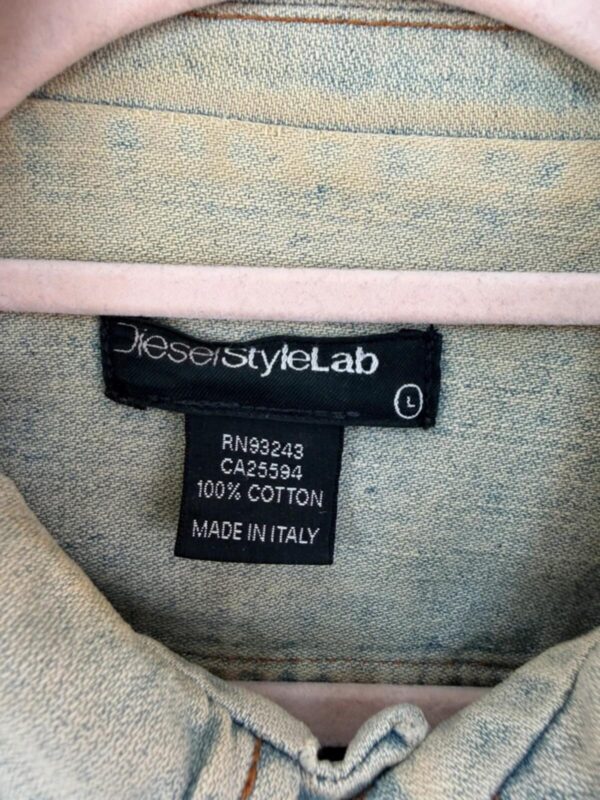
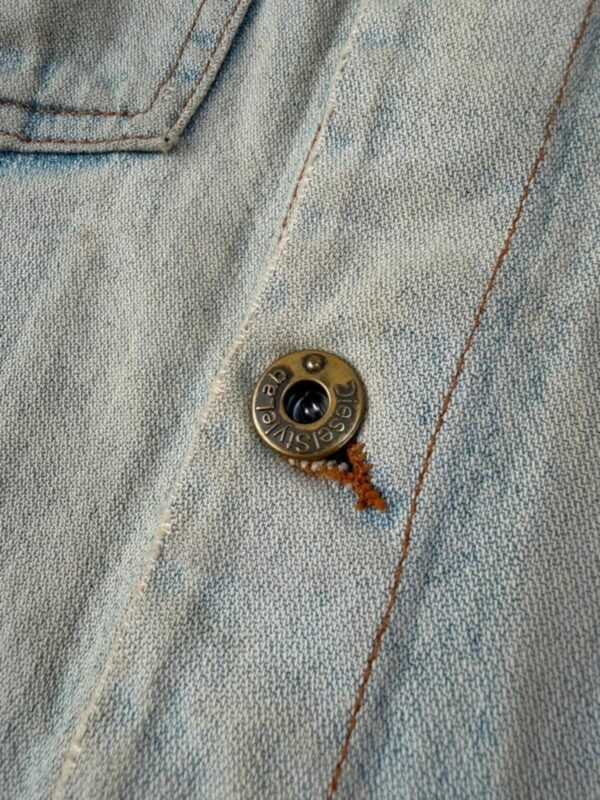
The DieselStyleLab label with size and composition, and the metal button: engraved, with the maker's mark on the back, stitched through a reinforced placket.
See this piece →Dolce & Gabbana (D&G)


The "D&G Glamour Woman" waistband label and the engraved D&G button. The care tag behind the label carries the composition, the size and the style code, which is where a wrong code shows.
See this piece →True Religion
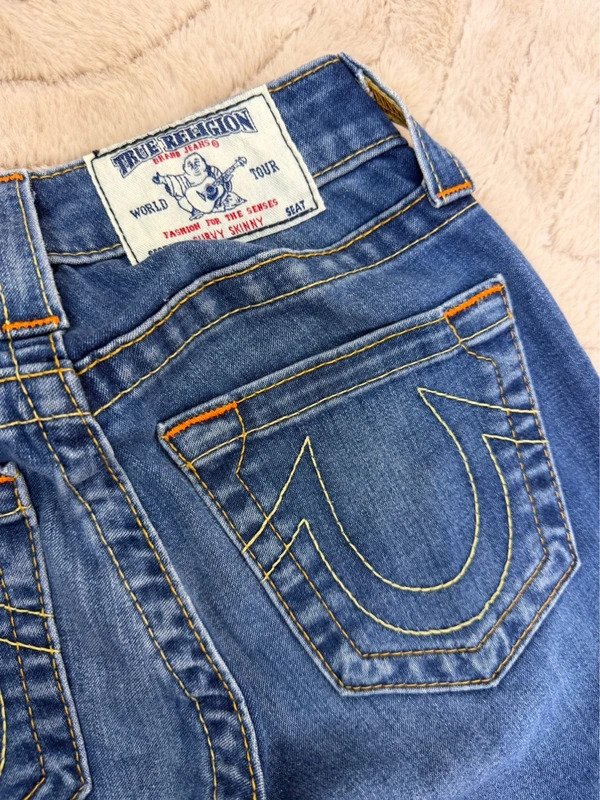
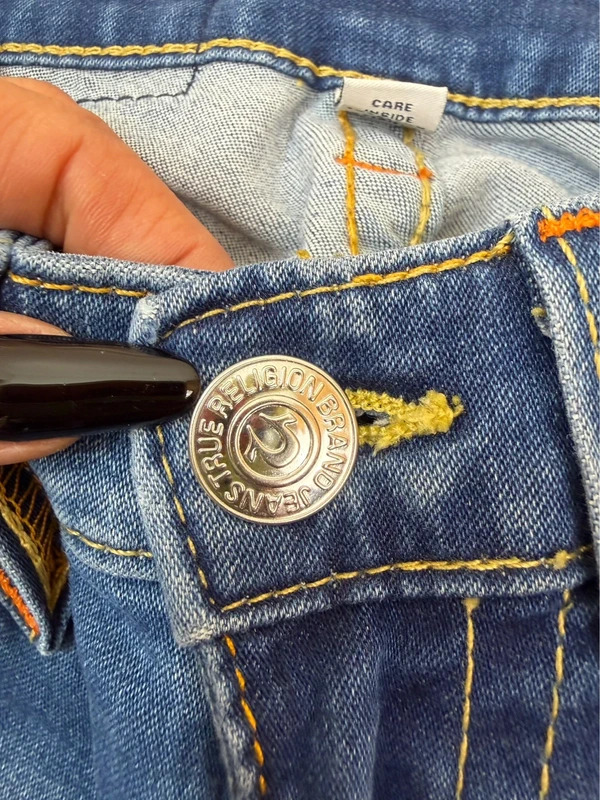
The woven tag at the waist, the horseshoe stitched on the back pocket with the heavy contrast thread, and the engraved buttons and rivets. Thread weight and stitch density are the first things we look at on this brand.
See this piece →Bags and leather goods
On a bag, most of the evidence is inside: the heat stamp, patch or plate, the creed or code tag and whether its style number matches the model, and the engraving on zips, snaps and clasps. Then the outside: edges, corners, handle fixings and how the lining is sewn in.
Coach
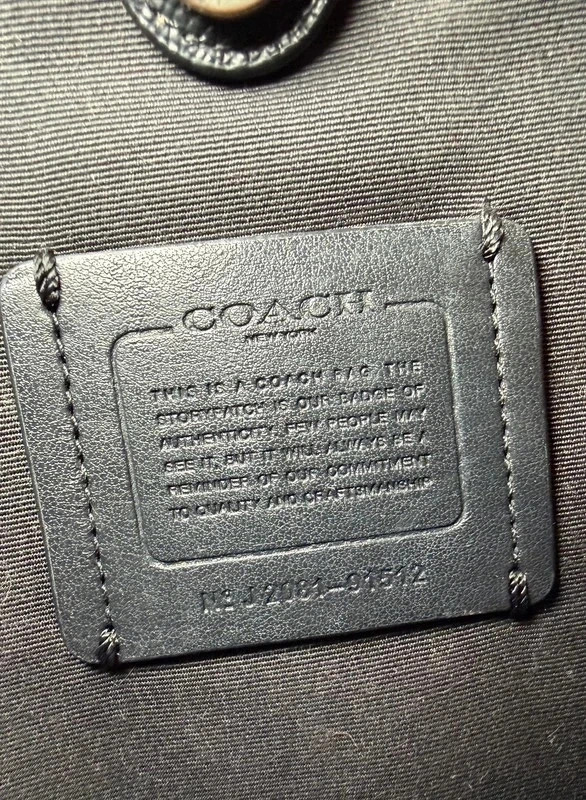
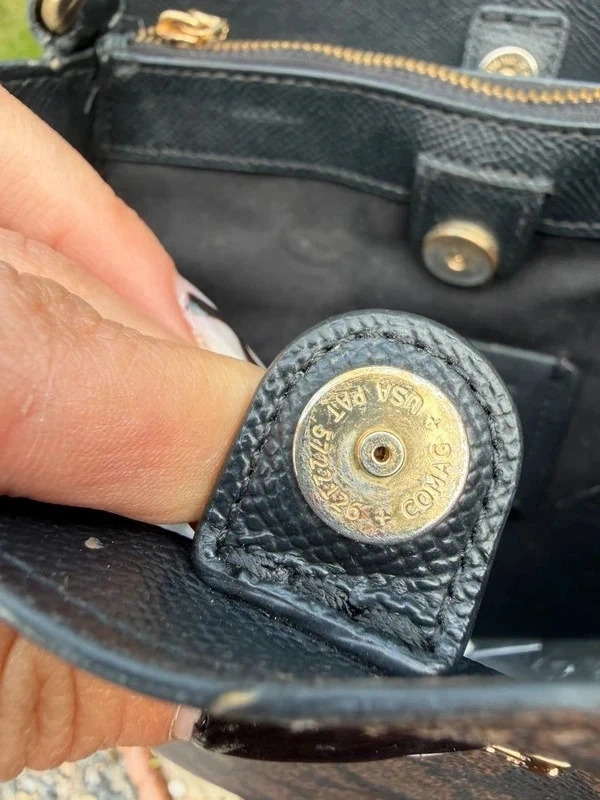
The creed patch stitched inside. Its code ends in the style number, and the style number has to match the bag: "No. J2081-91512" on this Town Bucket Bag is style 91512. The snap is engraved too.
See this piece →Furla


The metal plate inside, "Furla Genuine Leather", and the white production tag sewn into the lining with its codes. The plate, the tag and the engraved snap and zip pull have to tell the same story.
See this piece →Vivienne Westwood
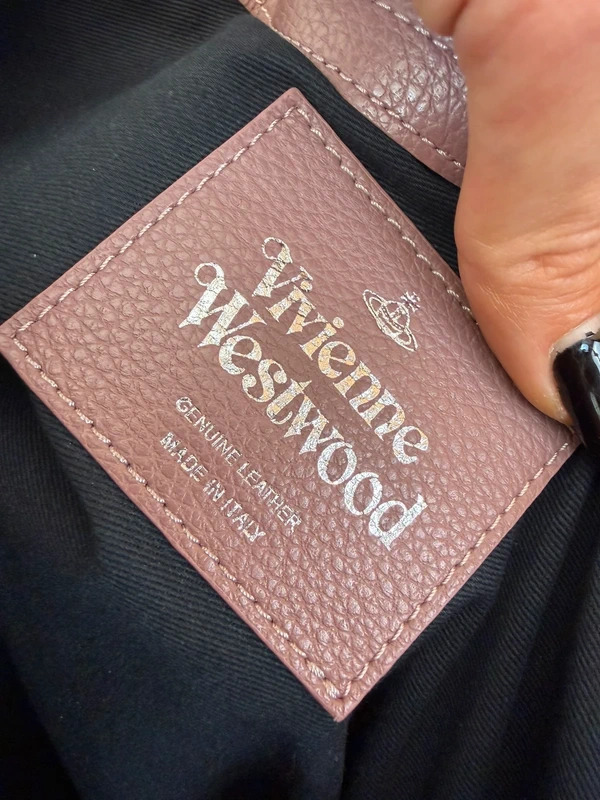
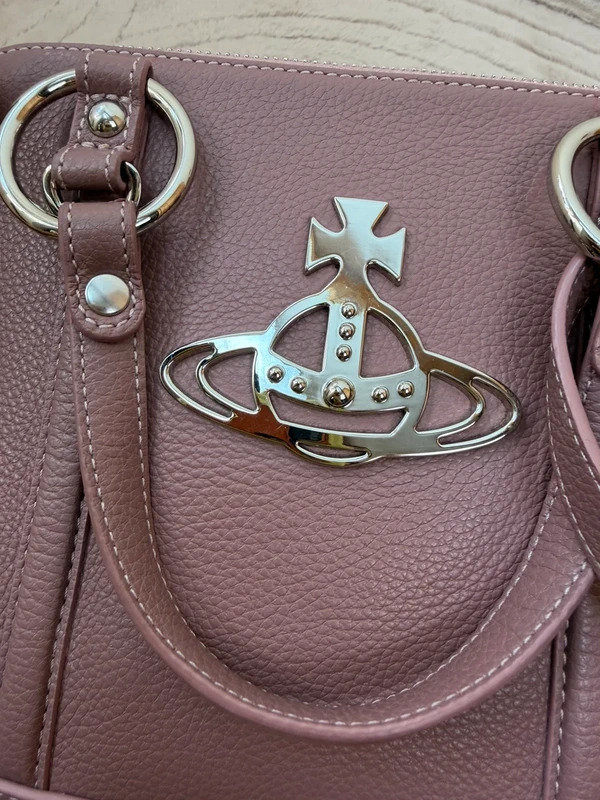
The leather patch inside, stamped "Vivienne Westwood", "Genuine leather" and "Made in Italy", and the orb on the front, the brand's signature hardware: its shape, finish and fixing are what we look at first.
See this piece →Alexander McQueen


The McQueen name stamped into the leather tab of the inner zip pocket, and the numbered leather tag stitched inside the bag. We check both, with the zips and the hardware, against the brand's known details for the Novak.
See this piece →Go deeper: Real vs faux: shearling, sheepskin and leather.
Cashmere and knitwear
Real cashmere starts with the composition tag: it should say 100% cashmere, or give the exact blend. Then the knit should agree with it: dense, even and soft, light for how warm it is.
- The composition tag. “100% cashmere” or the exact percentages. A blend such as 70% cashmere and 30% silk is real cashmere, but not 100%, and it should be described as a blend.
- The brand label and the care tag together. They should belong to the same brand and the same years. Knitwear sold in the US often carries an RN number on the care tag.
- The knit. An even, dense knit; very thin, see-through knitting at a cashmere price is a reason to look closer.
- Pilling. Small bobbles at the underarms and cuffs are normal for cashmere and are not a sign of a fake.
Brora


The neck label, "Brora, Scottish Cashmere", and the care tag sewn below it: "100% cashmere", 30° hand wash, dry flat, out of direct heat, and an RN number. The label, the tag and the knit itself have to agree.
See this piece →Repeat


The Repeat neck label and the composition tag: "70% cashmere 30% silk", repeated in German, with the article number. A blend is still cashmere, but it is not 100%, and the product page should say the blend.
See this piece →Go deeper: Is it real cashmere? What the labels say · what the care labels say.
Leather, sheepskin and Afghan coats
Real sheepskin is one material: the wool grows out of the skin, so the inside of the coat is the fleece and the outside is the suede side of the same skin. Faux shearling is a fabric with a pile on a woven or knitted backing.
- Part the wool. On real sheepskin you see skin at the roots; on faux shearling you see a backing fabric.
- The cut edges. At cuffs, hems and seams real sheepskin shows the thickness of the skin; faux shows fabric.
- The label. Real sheepskin coats often say so (“real sheepskin”, “genuine shearling”); faux ones list fibres such as polyester, acrylic or modal.
- Leather jackets. The care tag names the leather (for example lamb leather) and the lining separately; the hardware on a branded jacket is usually branded too.
- Penny Lane and Afghan coats exist in real sheepskin and in faux. Both can be genuine vintage; the difference is the material, and the title should say which.
Real sheepskin
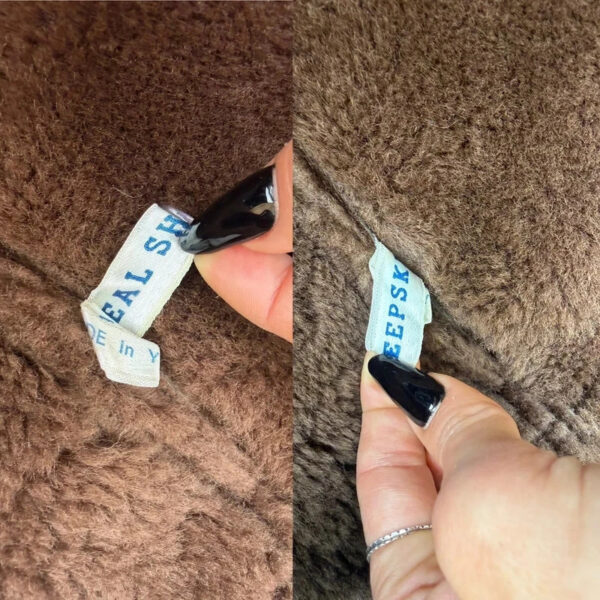

The "Real sheepskin" label inside the coat, and the inside itself: the fleece is the coat's own wool, one piece with the suede outside, with no separate lining sewn in.
See this piece →Faux shearling (Penny Lane coat)
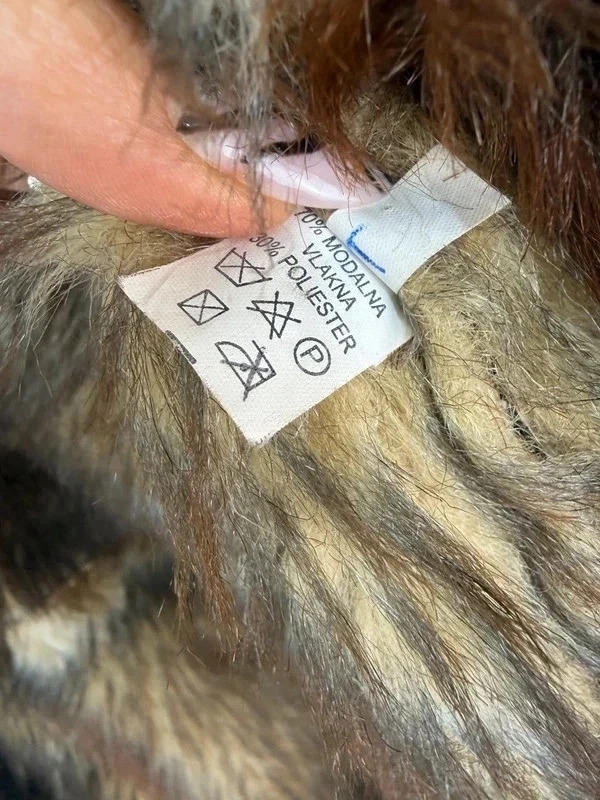
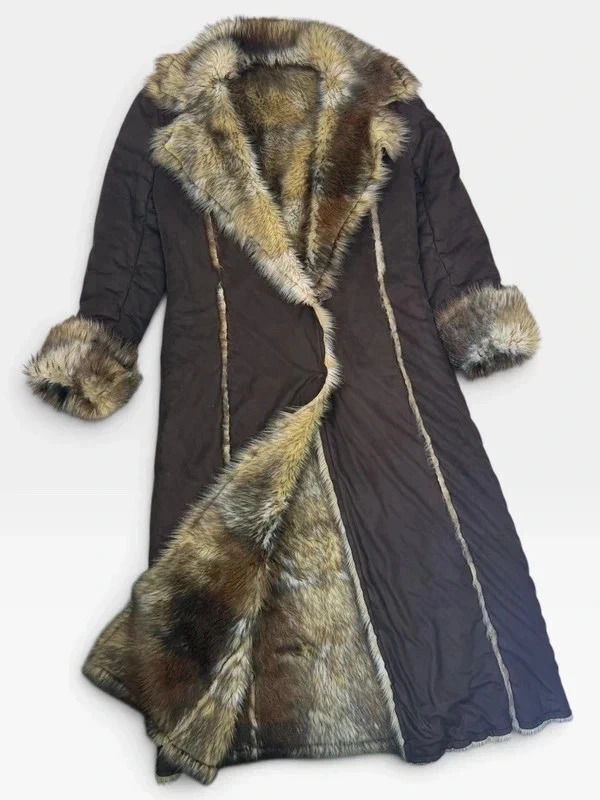
The composition tag, 70% modal and 30% polyester, and the coat reversed: a sewn fabric shell on one side, faux fur on the other. A faux coat is still genuine vintage, and we say faux in the title.
See this piece →Karen Millen leather


The care tag of the jacket: outer 100% lamb leather, lining 100% viscose, the origin of the leather, the country of manufacture and an RN number; and the zip pull, engraved KM.
See this piece →Go deeper: Real vs faux: shearling, sheepskin and leather.
Silk
Real silk is confirmed by the composition tag (100% silk, soie, seta, Seide) and by the fabric: a soft, dry hand and a natural sheen. Polyester tends to look glassier and feel slippery.
- Shell and trim. Good labels list the main fabric and the trims or lining separately; read both.
- The brand label and the size system. The label should match the brand's labels from the piece's era, and the sizes printed on it should make sense together.
Chloé
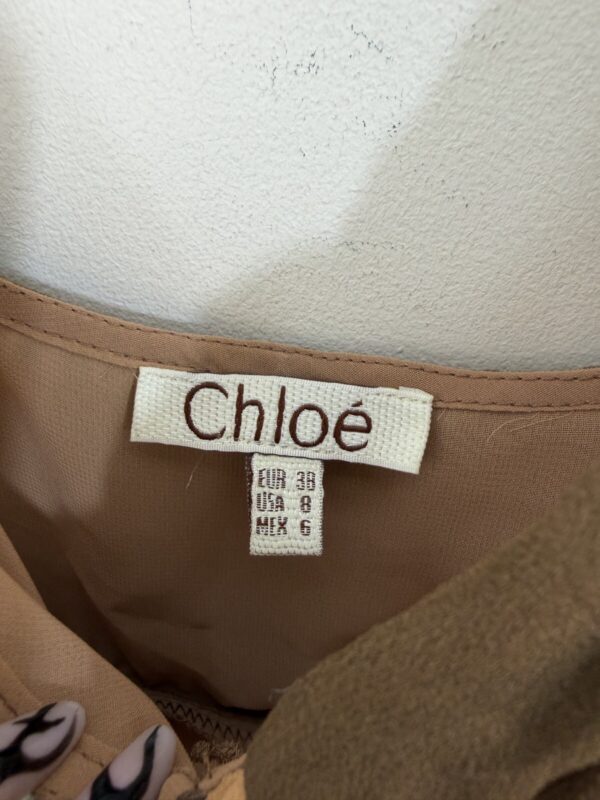
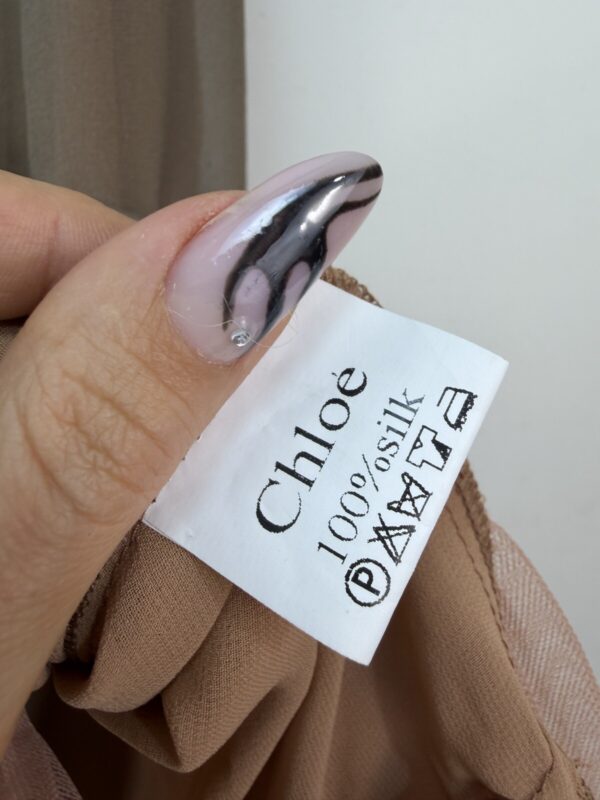
The Chloé neck label with its size in three systems (EUR 38, USA 8, MEX 6), and the care tag: "100% silk".
See this piece →Diane von Furstenberg
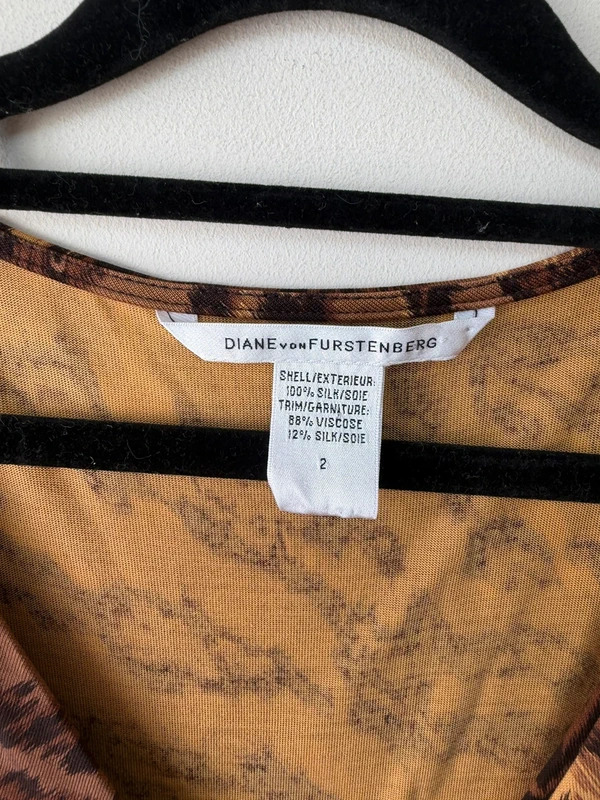
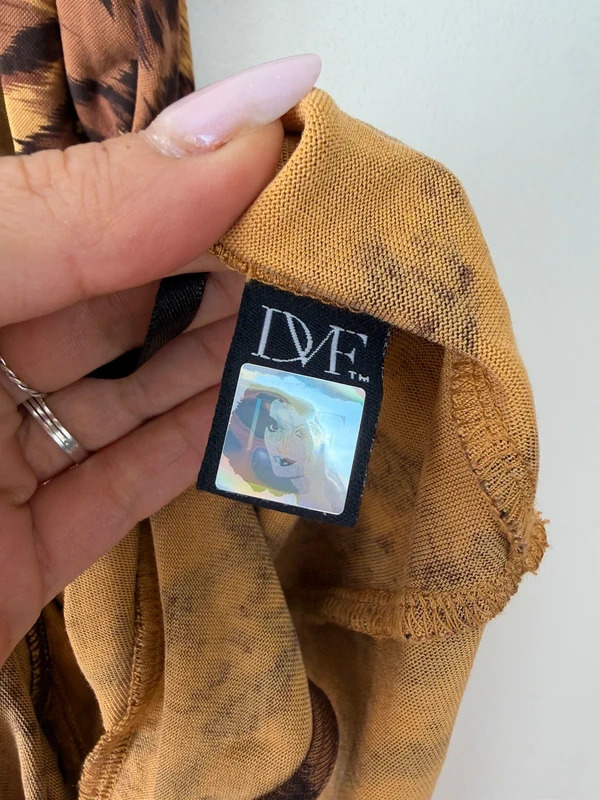
The composition label lists the dress and its trim separately: shell 100% silk, trim 88% viscose and 12% silk. The second photo is the DVF label with a holographic panel.
See this piece →Go deeper: Is it real silk? What the labels say · what the care labels say.
Designer labels across the decades
A designer label is read together with the tags behind it: the maker's tag, the care tag and any style code have to belong to the same line and the same years as the label.
- Younger lines have their own labels. D&G was Dolce & Gabbana's younger line, Moschino Jeans and Love Moschino were Moschino's, Versus was Versace's, McQ was Alexander McQueen's. A piece should carry the label of its line.
- The maker's tag. Behind the brand label there is often a tag naming the company that made the piece, with its town and country.
- The care tag tells the time. Wording, languages and legal references change over the years: Italian care tags from the 1990s and 2000s often cite the 1973 textile labelling law (n. 883).
- Security labels. Some brands added holographic labels in the 2000s; where a brand used one, it should be there and look right.
- The logo itself. Fonts, spacing and logo shapes changed over the decades; a label should look like the brand's label from the piece's era.
D&G (Dolce & Gabbana)
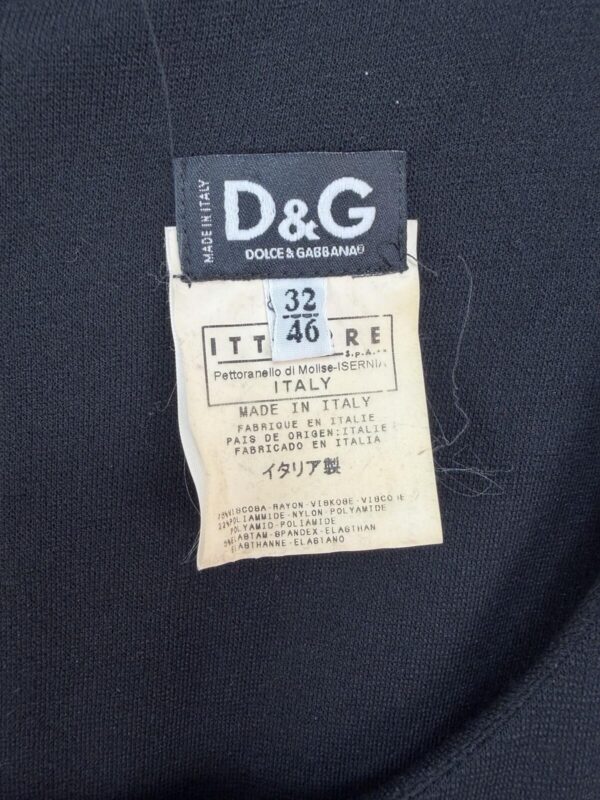
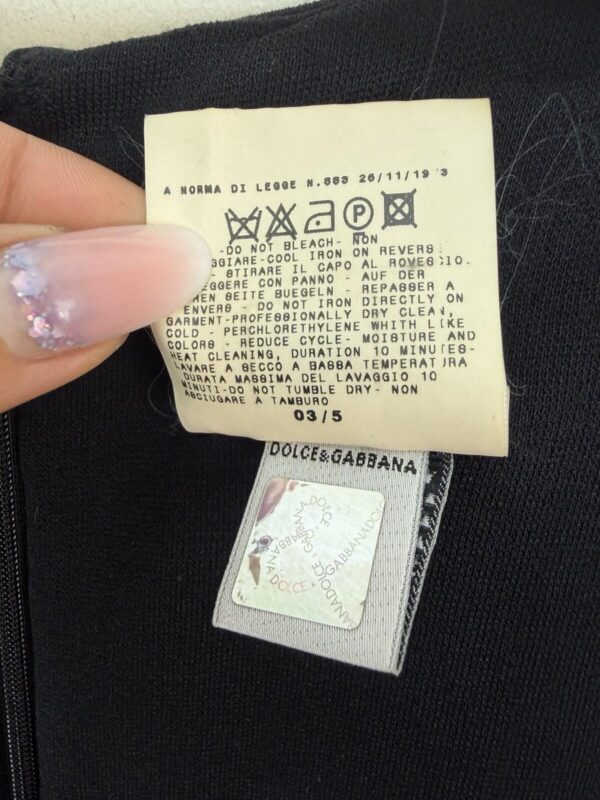
The black D&G label with the maker's tag of Ittierre S.p.A., Pettoranello di Molise, Italy, below it, and the care tag citing the Italian textile labelling law of 1973 (n. 883), with a holographic Dolce & Gabbana tag sewn beside it.
See this piece →Moschino Jeans and Love Moschino


The "Moschino Jeans" waistband label on a pair of jeans, and the gold button of a Love Moschino skirt, engraved with the line's name around the heart emblem. Each line has its own label and hardware.
See this piece →Versus Versace


The "Versus Versace" label inside the neck and the metal Versus plate stitched onto the rib knit. Versus was Versace's younger line, and its pieces carry its own name.
See this piece →Go deeper: How to date vintage clothing from its label: RN and CA numbers, country, care wording and fibre names as decade clues.
Questions people ask
How can you tell if vintage designer clothing is real?
Check several things together: the brand label, the care and composition tag behind it, the stitching, the hardware and any style or serial codes. They have to agree with each other and with the era the piece is from. No single detail is proof; a real piece is one where everything adds up.
Are Kitanesque pieces genuine?
Every piece is checked by hand by Andra before it is listed, and a piece that does not add up is not listed. If one ever turns out not to be genuine, tell us within 30 days of delivery: we email you a prepaid returns label and refund you in full.
How do you tell if cashmere is real?
Read the composition tag first: it should say 100% cashmere or give the exact blend, such as 70% cashmere and 30% silk. Then look at the knit: dense, even and soft, light for its warmth. Some pilling at the underarms and cuffs is normal for cashmere and is not a sign of a fake.
How can you tell real sheepskin from faux shearling?
Part the wool. On real sheepskin it grows out of the skin, and the inside of the coat is the fleece itself, one piece with the suede outside. Faux shearling has a woven or knitted backing, and its label lists fibres such as polyester, acrylic or modal.
How do you know if a silk dress is real silk?
The composition tag should say 100% silk (soie, seta, Seide), with any trim listed separately. Real silk has a soft, dry hand and a natural sheen; polyester tends to look glassier and feel slippery.
How do I read the code on a Coach creed patch?
On the leather creed patch inside the bag, the part after the dash is the style number, and it should match the model. On our Coach Town Bucket Bag the creed reads No. J2081-91512, and 91512 is that bag's style number.
Is a "Made in Italy" label proof that a piece is real?
No. It is one detail among several. A real Italian-made piece has a label, a care tag and construction that agree with each other and with the brand's labels from that era; a country of manufacture on its own proves nothing.
Are D&G, Love Moschino and Versus real designer?
Yes. D&G, Moschino Jeans, Love Moschino, Versus Versace and McQ were the designers' own younger lines. Each carries its own label, and a piece should have the label of its line, consistent with its care tag.
What if a piece turns out not to be genuine?
Tell us within 30 days of delivery. We email you a prepaid returns label and refund you in full as soon as the piece is back with us.
What we do not do
- We are not the brand and not a third-party authentication service, and we do not issue certificates. What you get is the judgement of someone who has handled these labels every week since 2015, and the photos to check it against.
- We do not sell pieces we are unsure about, and we do not describe a reworked or customised piece as original: the Atelier pieces say so in the title.
- We do not buy from or sell on behalf of customers, so everything here was chosen and checked by us.
If we are wrong
If a piece ever turns out not to be genuine, tell us within 30 days of delivery. We email you a prepaid returns label and refund you in full as soon as the piece is back with us. The full returns terms are on the Shipping & returns page and in the FAQ.
And then
Once a piece passes, it is measured flat by hand in inches (bust, waist, hips, length, rise, inseam) and the numbers go onto the product page and into Will it fit?; it is washed or cleaned, photographed on Andra, and every flaw we found is written down. Not sure about a piece? Ask us before you buy, or use the WhatsApp button on the product page.