What Makes Cashmere Expensive, and When the Cheap Stuff Is Fine

UK delivery from this site · prices in GBP · Outside the UK? Find our pieces on eBay and Vestiaire Collective, which ship internationally.
There comes a point, usually in the third winter, when a cheap cashmere jumper stops pretending. The elbows go thin enough to read through. The underarms grow a fuzz that no amount of combing will shift. Nothing on the label has changed, mind. It still says 100% cashmere, and it is still, strictly speaking, telling the truth.
Cashmere used to be a word that meant money. It now means cashmere, which is a much smaller promise than it sounds. This is a guide to what sits behind the word: how the fibre is made, what separates a £25 jumper from a £300 one, where the brands fall and why, and how to judge a second-hand piece in two minutes with your hands and a window.
How cashmere came down in the world
For most of the last century a cashmere jumper was a Scottish or an Italian thing, knitted in Hawick or in Biella, sold in shops with carpets, and worn for thirty winters by people who saw no need to mention it. Then, in the 2000s, the supermarkets and the fast-fashion chains discovered the fibre. Tesco’s F&F put a 100% cashmere V-neck on the rail next to the school uniforms. Uniqlo, Zara and H&M followed, at prices that had lately bought a wool blend, and Marks & Spencer, which had quietly sold cashmere for decades, found itself with company.
The fibre was real. That was the clever bit. Nobody was lied to. What changed was everything the label declines to mention: how long the fibres were, how much yarn went into the garment, how the pieces were joined, and where the goats were standing while they grew the stuff.
Where the fibre comes from
Cashmere is the winter undercoat of a goat, combed out each spring on the high, cold plateaus of Inner Mongolia, Mongolia, Afghanistan and Iran. The coarse outer guard hair is separated from the fine down in a process called dehairing, and what is left is the fibre itself: roughly 150 grams a year from one animal. A woman’s jumper wants the down of two or three goats; a man’s cable knit, four or five. That scarcity is the whole reason the word ever meant money.
When the world decided it would like cashmere at £45, the herds obliged. Mongolia’s goat population has grown roughly fivefold since 1990, and by most reckonings a large part of its grassland is now degraded, grazed to the root by animals whose purpose is to keep the jumper cheap. Second-hand, none of that gets any worse. The goat has already been combed.
Grade, which no label prints
Once dehaired, the fibre is sorted by fineness and by length. The best is under about 15.5 microns thick and longer than 34 millimetres; lesser grades are thicker, shorter, or both, and anything much over 19 microns is not really cashmere at all. Fineness is what you feel on the neck. Length is what you feel under the arms a year later. A short fibre has fewer points at which the twist of the yarn can hold it, so it works loose and rolls itself into a pill. Long fibres stay where they were put.
Length, in short, is money. No high-street label prints a micron count. Nor, to be fair, does Brora. The information exists, in the mill, and goes no further. So you test it yourself: rub the sleeve against itself for ten seconds. Fuzz means short fibres; nothing much means long ones. It is an undignified way to judge a luxury, and the only reliable one I know.
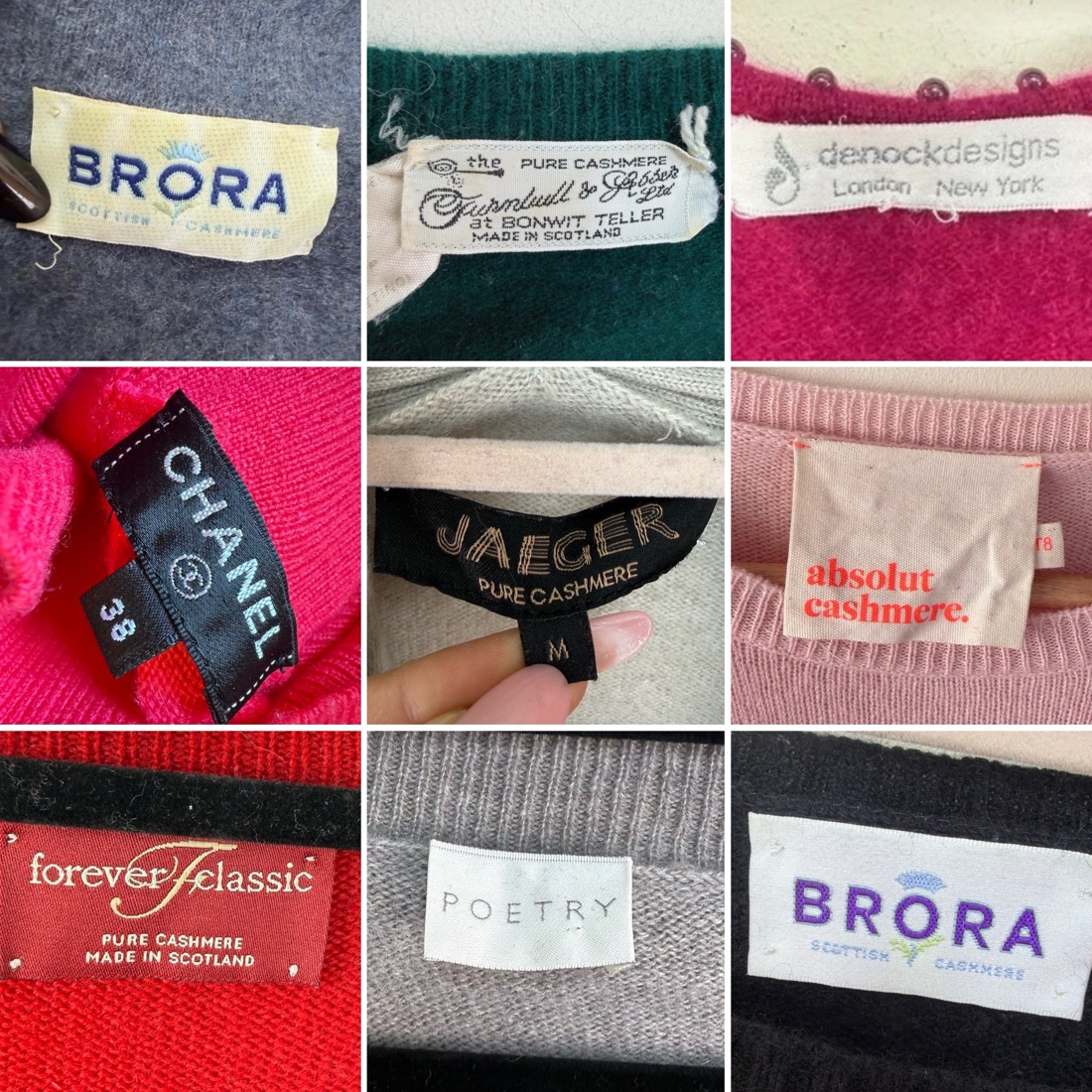
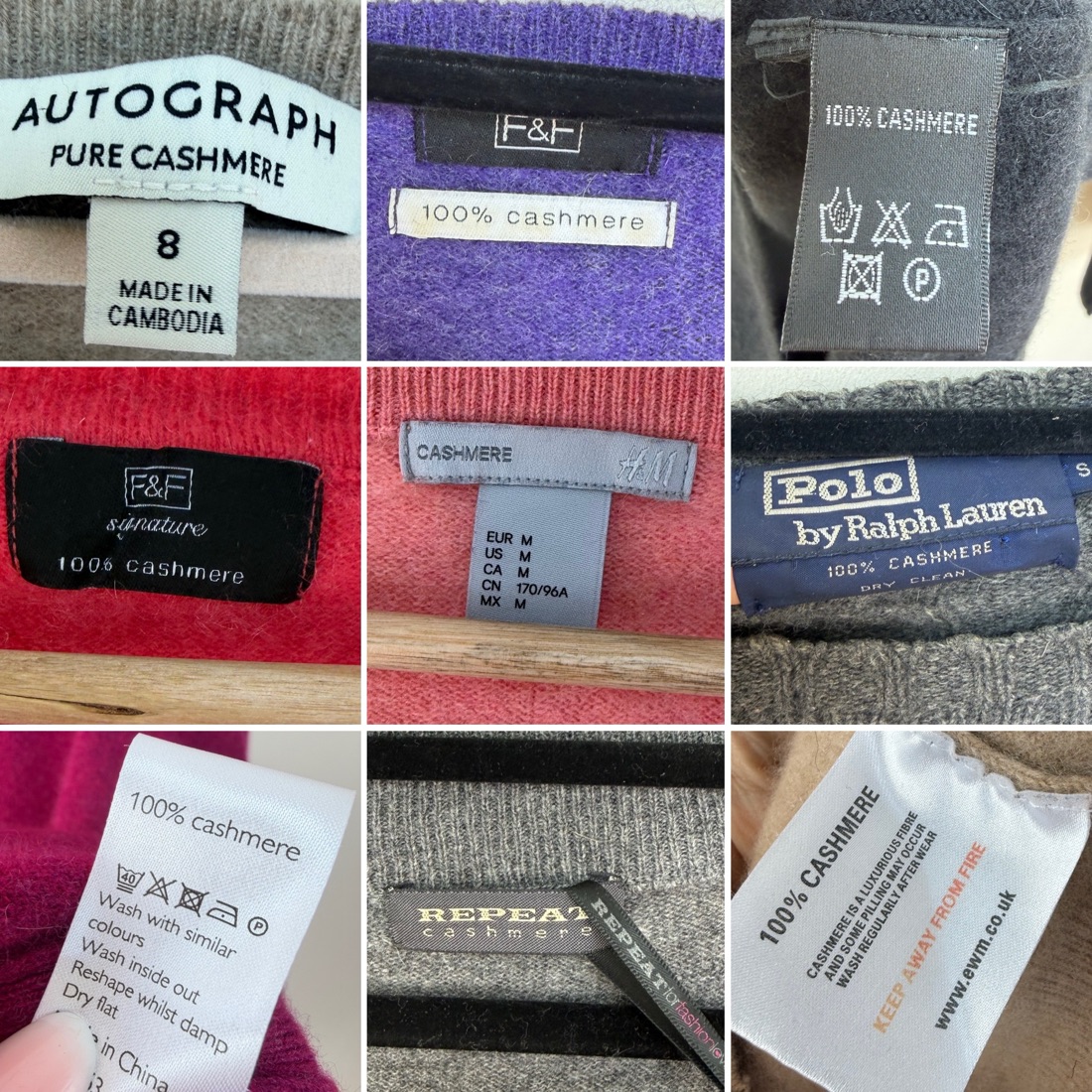
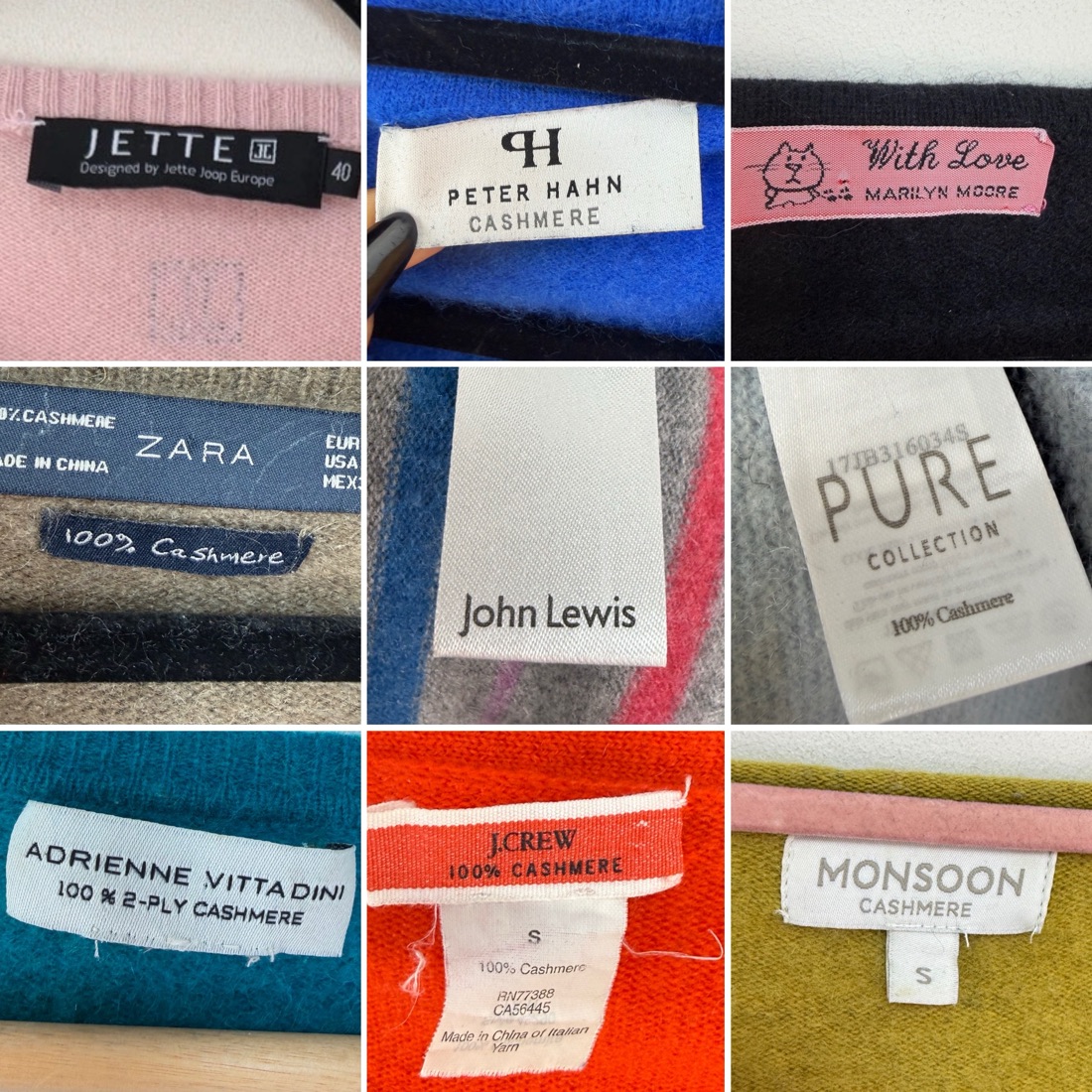
Twenty-seven labels, from Chanel down to F&F. Between them they print a fibre content, a size, a country and a wash symbol. One of the twenty-seven says 2-ply. Not one gives a micron count or a fibre length, which are the two numbers that decide how the jumper will look in three years.
Two-ply, and other reassurances
Two-ply is the phrase a brand reaches for when it would like to sound like a mill. A ply is one spun strand; 2-ply is two of them twisted together into a single yarn before anyone knits with it. Most of the jumpers in the country are 2-ply. The gossamer summer ones are 1-ply, the chunky winter ones 4-ply and up. It describes the construction of the yarn and says nothing whatever about the fibre inside it. A 2-ply yarn spun from short fibres pills precisely as fast as it was always going to.
Exactly one label in the wall above bothers to print it: an Adrienne Vittadini that says 100% 2-ply cashmere, and it is a mid-market American knit rather than a mill piece. Read ply as a weight, then move on. Gauge is the other number the mills quote: a 12-gauge knit is fine and close, a 7-gauge is thick and cosy, and both can be made well or badly.
Where the money actually goes
Hold two 2-ply jumpers of the same size up to a window. One lets the daylight through the body in a fine mesh; the other does not. The difference is yarn, sometimes a third of the garment’s weight, and it is the cheapest place to save money because nobody has ever weighed a jumper in a shop.
Now turn them inside out. A jumper knitted to shape, which the trade calls fully fashioned, has flat linked seams and not a cut edge anywhere, each piece having been knitted to precisely that size. A cheaper one was knitted as flat cloth, cut out like a T-shirt and overlocked, and the serged edge inside the shoulder gives it away. Most Scottish and Italian mill pieces are knitted to shape. Most supermarket ones are cut and sewn. That is hours of work, or the absence of them, folded quietly into the price.
Then there is finishing. The good ones are washed and pressed in the mill, in soft water, until the yarn blooms and the surface closes up. The cheap ones are dressed with softeners that feel wonderful in the changing room and rinse out in the first wash, leaving behind a thinner knit than the one you paid for. Good cashmere is soft and has a bit of body. Cashmere that feels slippery, almost damp, has been helped.
Three tiers, and why the prices are what they are
It helps to see them side by side, and a second-hand rail can arrange that in a way a department store cannot.


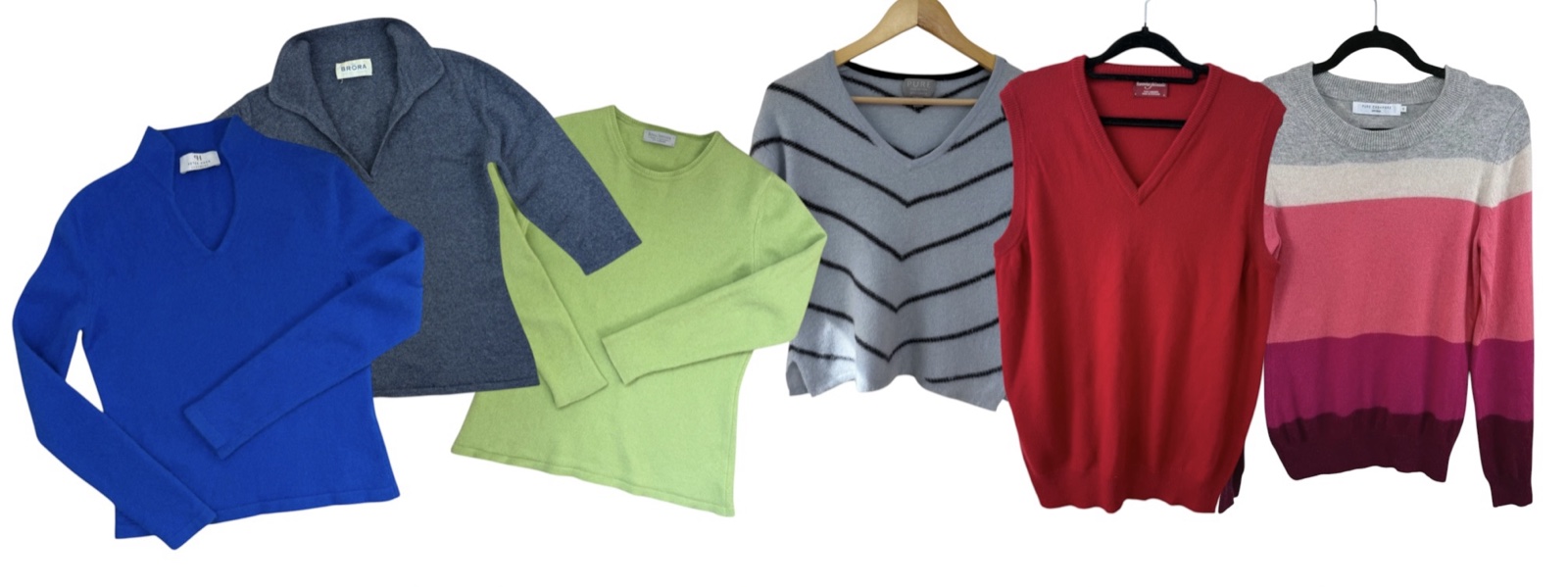
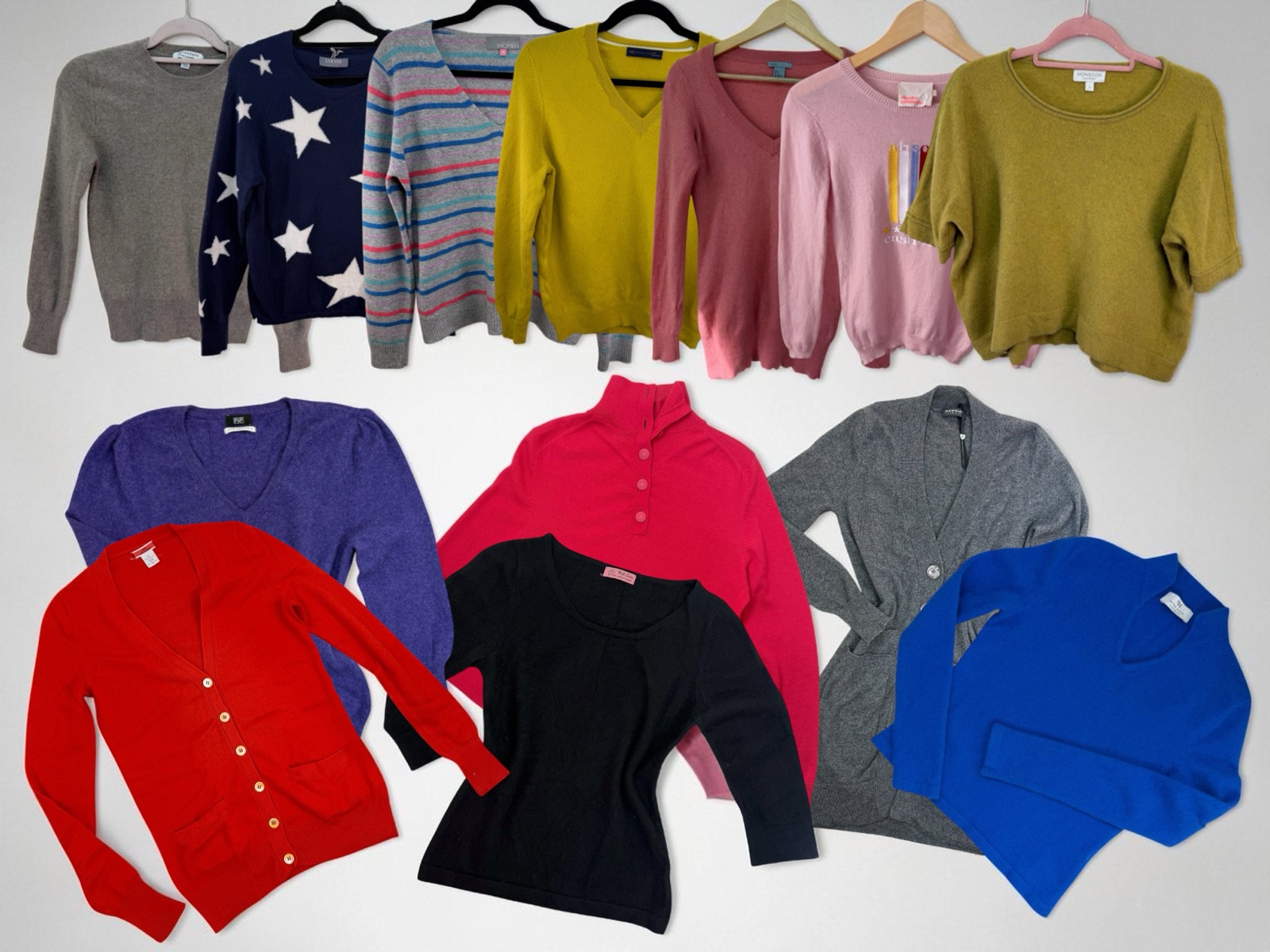
The supermarket and the high street. F&F, M&S, H&M, Uniqlo, Zara. Perfectly real cashmere, new for somewhere between £45 and £150 depending on the year and the sale. Light on yarn, loose to average in the knit, usually cut and sewn, and the fibre is whatever grade the buyer could get at that price. Pilling starts early and the elbows go after two or three winters of honest wear. Second-hand, though, they are the cheapest way into the fibre there is: the F&F purple V-neck on my rail is £25, the M&S fuchsia boat neck £38. And a five-year-old high-street jumper that has not gone thin has already passed the one examination a new one can only promise to sit.
The middle. John Lewis, Pure Collection, Cocoa Cashmere, Absolut Cashmere, Repeat from Switzerland, J.Crew, Whistles. Better grades, heavier knits, mostly knitted to shape, somewhere between £90 and £250 new. This is the tier people argue about over lunch: at full price it asks you to pay for a name that has not quite finished earning it. At a third of the price the argument dissolves. The John Lewis colour-block is £48 here, the J.Crew orange cardigan £45.
The top. Brora, N.Peal, Johnstons of Elgin, Begg & Co, Barrie, Pringle, and the Italians, Loro Piana and Brunello Cucinelli. Long fibres, dense yarn, knitted to shape in Scotland or Italy, washed and finished in the mill, and made to be worn for twenty years and then handed down. New, £250 to £500 for the Scots and a good deal more for the Italians. Second-hand the gap is the whole argument: the black Brora crew neck is £120 on my rail, the N.Peal V-neck £135, the Turnbull & Asser knitted in Scotland £135, each a fraction of what the same mill charges for the same yarn today.
So what are you paying for at the top? Not the name, or not mostly. Fibre grade, yarn weight, the hours of fully fashioned knitting, the finishing, and a mill that has been doing it since before the word became a marketing term. The high street sells you the word. The mill sells you the jumper.
Read the composition label before the brand label
Blends can be lovely. A cashmere-silk knit like the Repeat 70/30 slouchy V-neck drapes better than pure cashmere ever does, and a 65/35 cashmere-wool, like the UGG knit joggers, still feels like cashmere in the hand. But 10% cashmere in a merino jumper is a fibre used as seasoning, and it should be priced as merino. The percentage tells you the recipe; the order of the words on the label tells you which fibre is doing the work.


Shrunken, which means three things
The word turns up on labels, in shop copy and in my own listings, and it is doing three quite different jobs. Sometimes it is a cut: a shrunken cardigan is one designed short and close, as though it had met a hot wash, and nothing has happened to the fibre. Sometimes it is a process: boiled or felted cashmere is knitted loose and then washed hot on purpose until the fibres lock together, denser, warmer, matt, with very little pilling, and one or two Italian houses charge full price for the effect.
And sometimes it is an accident. A hot wash, a tumble dryer, and the scales on each fibre catch hold of their neighbours; the knit tightens and the jumper emerges a size smaller and rather thicker. Ruined? Seldom. Unless the wash was violent enough to leave the thing stiff as a board, a lightly shrunk cashmere is simply a denser one: warmer, less fluid, less inclined to pill. When I write “a slightly denser texture compared to regular cashmere” in a listing, that is what I mean, and I price it accordingly. If the shrinkage is mild you can coax back a centimetre or two: half an hour in lukewarm water with a capful of hair conditioner, squeezed rather than wrung, eased towards the measurements you want, pinned and dried flat. Proper felting does not negotiate.
Why the label size means so little in knitwear

A fitted rib and a batwing are both allowed to call themselves a UK 8, and the difference between them at the bust can be two feet. Knitwear stretches, drapes and was often designed oversized to begin with, so a cashmere piece is bought by the flat measurements or not at all. Every knit here lists bust, sleeve and length measured flat, the size guide shows how the tape is held, and if you know your own bust the fit finder will do the comparison for you.
How to look at one in two minutes
Underarms first, for pilling. Elbows and cuffs against the light, for thinning. Then the whole garment against the light for moth, whose holes are small and round and fond of seams and collars. Rub the sleeve for the fibre length. Feel it for body rather than slipperiness. Turn it inside out for the seams. Read every label, including the one somebody has cut out. Smell it: mothballs mean somebody cared. Two minutes, in daylight. It is more attention than most people give a £300 jumper in a shop with carpets.
Looking after it
Hand wash in cool water with a wool wash or a baby shampoo, or on a proper wool cycle at 30 degrees inside a mesh bag. Never wring. Roll in a towel, dry flat, away from the radiator. Fold it rather than hang it, since hangers pull at shoulders. Comb the pills off rather than picking at them; they thin out after the first few washes, once the short fibres that were always going to leave have left. Give it a day off between wears. Store it clean, with cedar or lavender, because moth prefers the unwashed.
Questions people ask
Is cheap cashmere real cashmere?
If a label sold in Britain says 100% cashmere, it must be. What differs is fibre length, the amount of yarn in the garment and the way it was knitted and finished, none of which the label discloses.
Does 2-ply mean better quality?
It means two strands twisted together, the ordinary jumper weight. It says nothing about the fibre. The rub test and the window test do.
Is Scottish or Italian cashmere really better?
Usually, but not because of the flag. Hawick and Biella have mills that buy long fibre, knit to shape and finish properly, and those three things are what you feel. The J.Crew label in the wall above puts it plainly: made in China of Italian yarn. A jumper built the same way anywhere would feel the same; most are not built the same way, because they are built to a price.
Is shrunk cashmere worth buying?
If the measurements fit, certainly. It is denser, warmer and pills less. Pay less for it than for an unshrunk piece, and buy by the flat measurements.
Cashmere or merino?
Merino is a sheep’s wool, springier, cheaper and harder-wearing; a good merino jumper is a better buy than a bad cashmere one. Cashmere wins on warmth for its weight and on softness against the skin. A 70/30 cashmere-merino blend is often the sensible answer for a jumper you will actually wear every day.
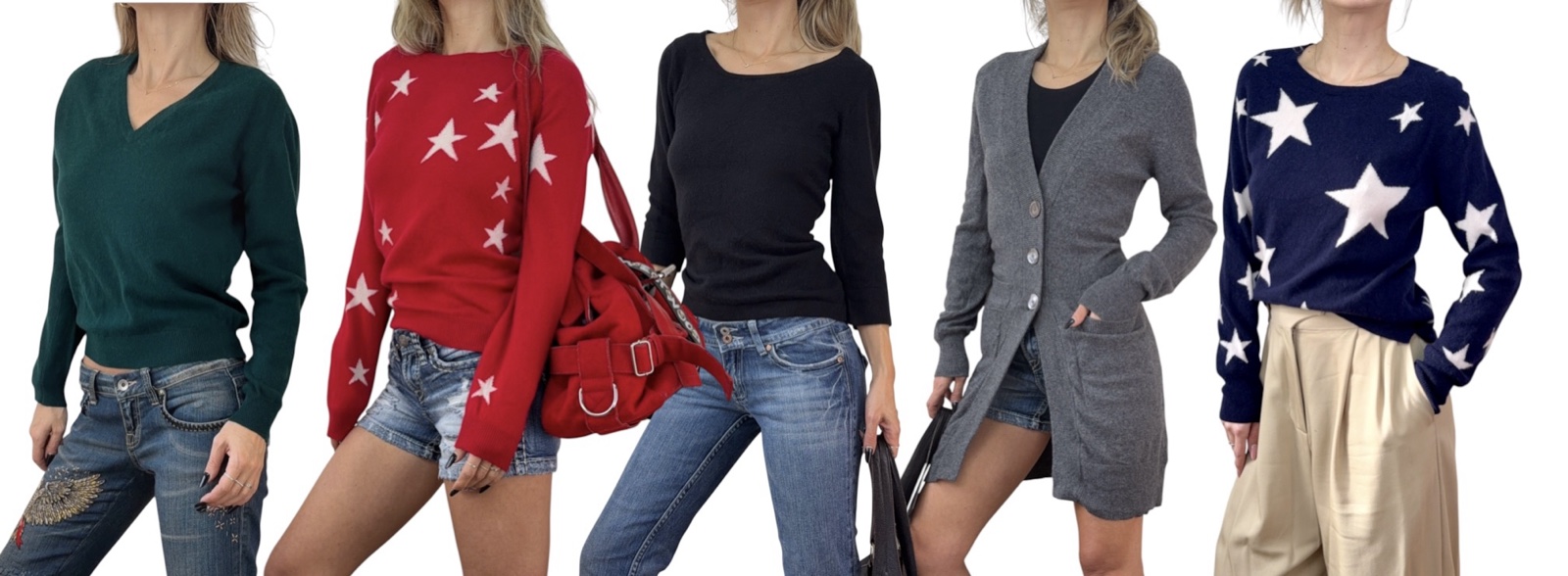
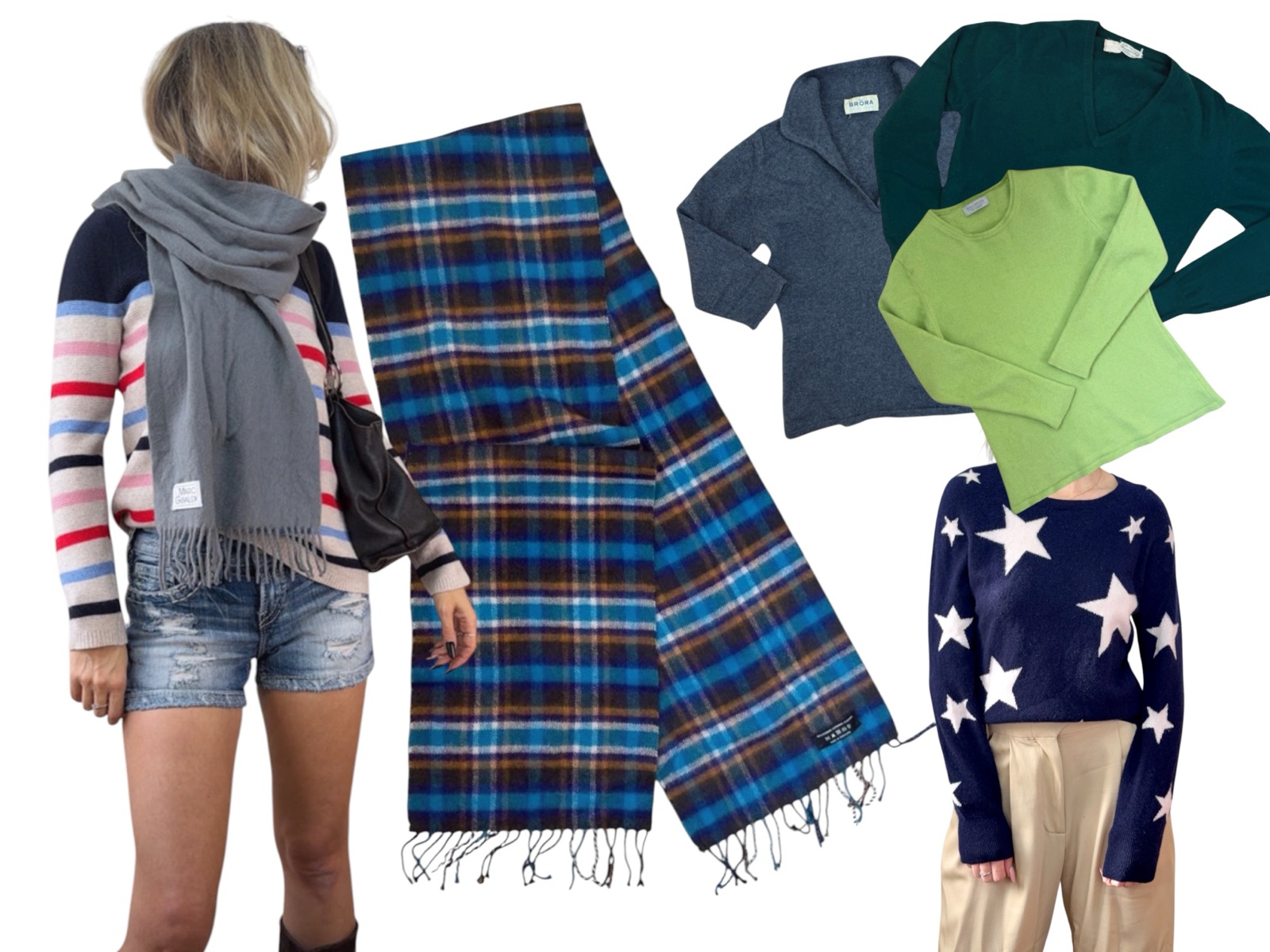
The rail is the argument. Start with the jumpers, then the cardigans, where most of the cashmere currently sits, and the scarves, which dodge the sizing problem entirely. Each piece is photographed with its labels and measured flat, so you can do the two-minute check from your sofa.
Compare labels side by side: Knitwear sizing by brand, one row per label, from every knitted piece we have measured.