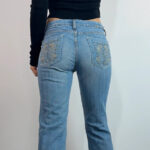
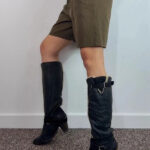
How to Measure Jeans: Waist, Rise, Inseam and Hem, Laid Flat the Way I Do Every Pair

UK delivery from this site · prices in GBP · Outside the UK? Find our pieces on eBay and Vestiaire Collective, which ship internationally.
Lay the jeans flat. Do the button up. Take five numbers: waist, rise, inside leg, thigh, hem.
A soft tape and ten minutes, and that is the whole method.
Every pair on my rail goes through it before the camera comes out. Sixty-two pairs of jeans so far.
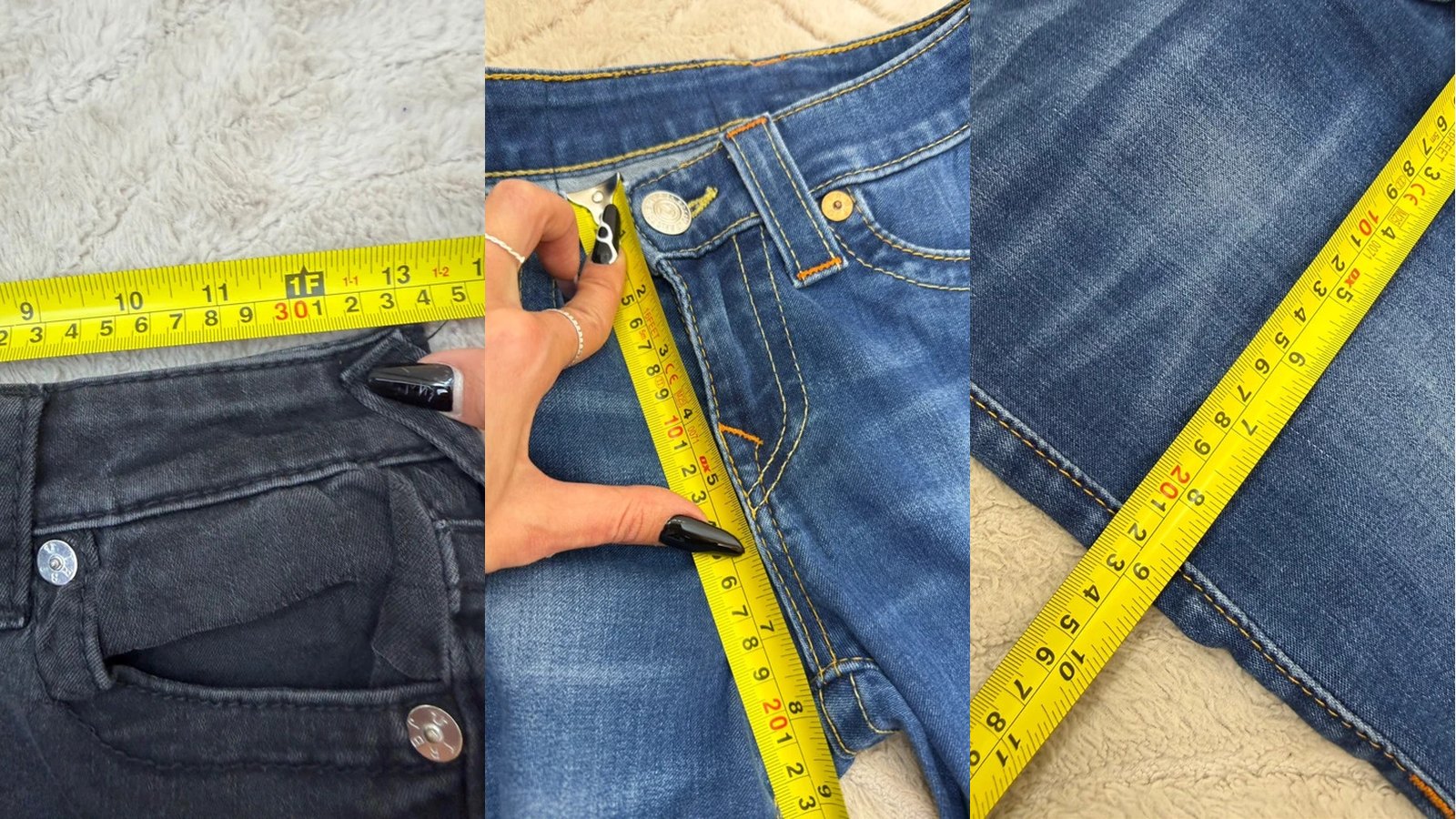
The figures below are theirs, and the photos are the tape on real pairs that are here now.
Before the tape comes out
A hard surface. A bed swallows the waistband and you lose half an inch without noticing.
Button and zip done up. An open low-rise waistband splays and reads bigger than it is.
Smooth the denim, then leave it alone.
Thirty-three of my 62 pairs have stretch in them. Pull the waistband on one of those and it gives you an inch for free, which the jeans take back the moment they are on you.
Inches, because that is what the labels use.
Jeans in stock now, each measured this way
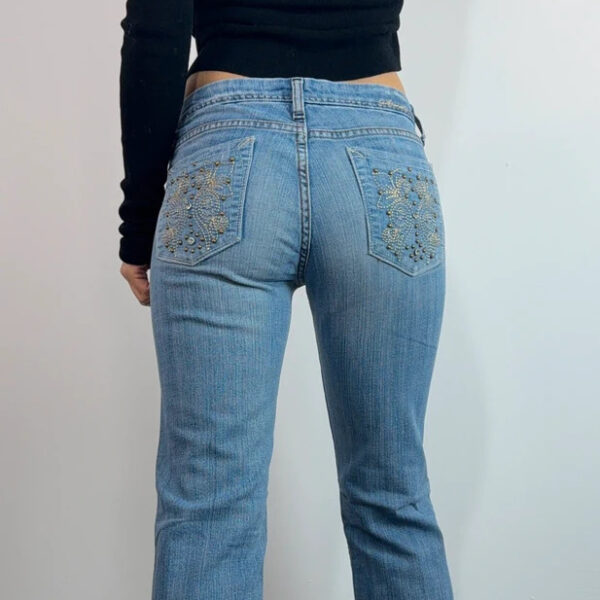 Anoname Womens Y2K Low 8”Rise Flare Jeans W29L33 UK10 Stud…W29 · UK 10Waist 32" round£28.50
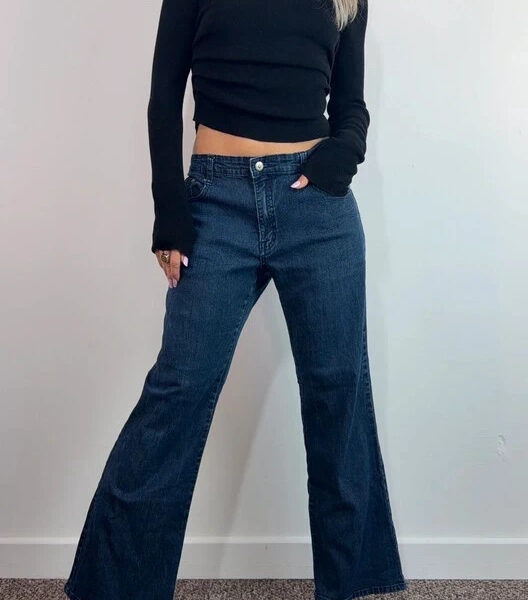 Cos Womens Jeans Y2K Mid 9.5”Rise Flare UK14 W34 L28 Petit…W34 · UK 14Waist 34" round£16.00
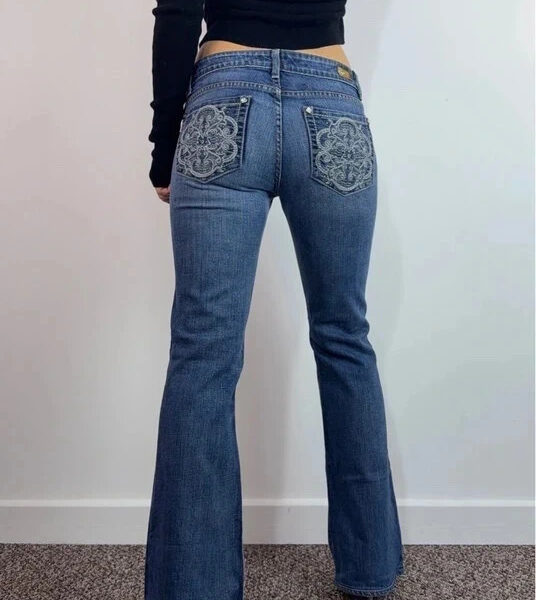 Paige Womens Y2K Low 8”Rise Flared Jeans W29 L31 UK 10 Emb…W29 · UK 10Waist 32" round£32.00
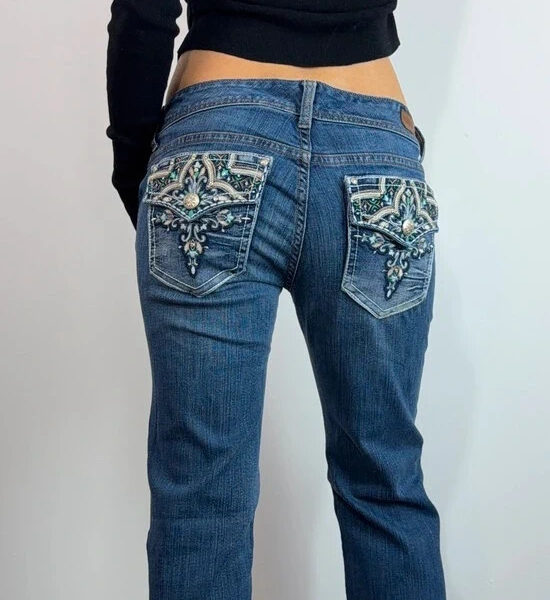 S.O.N.G Womens Y2K Low 7.5”Rise Bootcut Jeans UK10/12 W33 …W33 · UK 12 · UK 10Waist 33" round£30.50
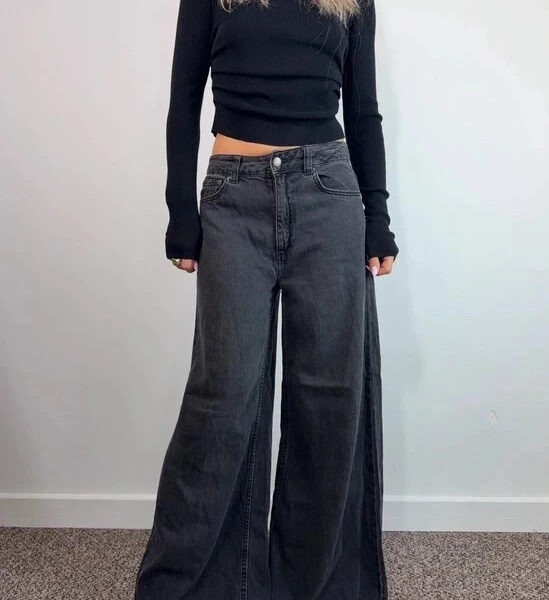 ASOS Womens High Rise 11.5” Wide Leg Flare Black Jeans W26…W26 · UK 8Waist 29" round£19.50
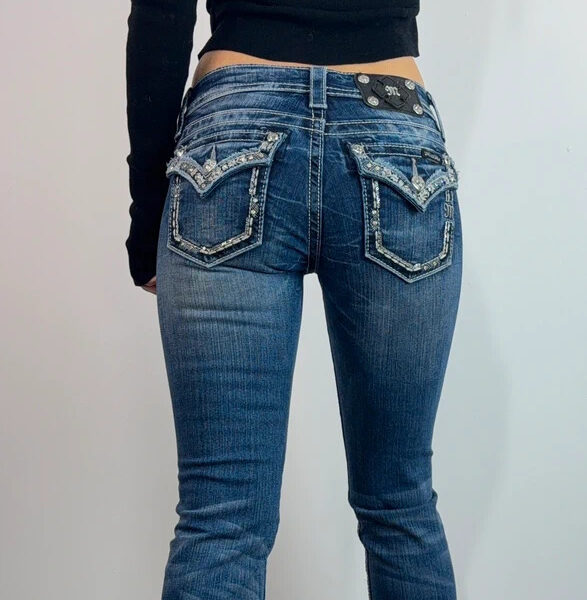 Miss Me Womens Low 7”Rise Straight Jeans W27 L33.5 UK 8 Y2…W27 · UK 8Waist 29" round£39.50
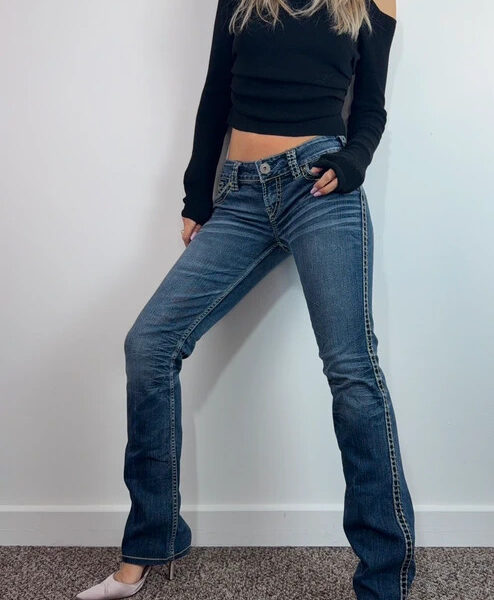 Silver womens bootcut low 7”rise blue jeans W29 L30.5 UK 8…W29 · UK 8 · UK 10Waist 32" round£28.50
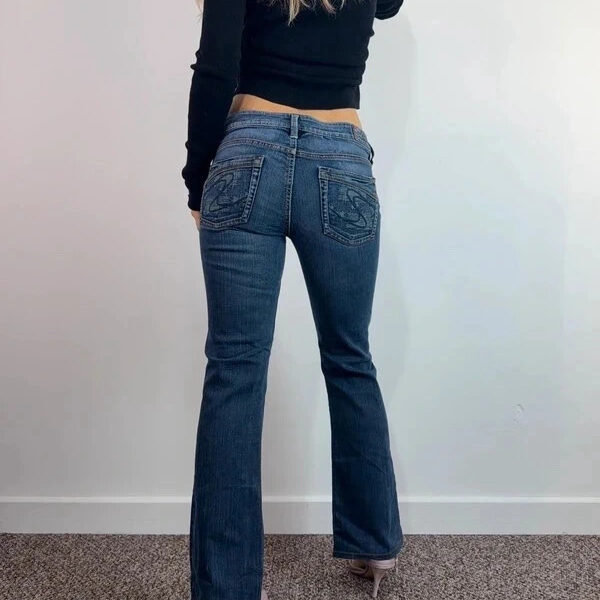 Silver Jeans Womens Low 7.5”Rise Flared Jeans W29 L29 UK 8…W29 · UK 8 · UK 10 · SWaist 30.4" round£32.00
One of each. Measured flat by hand, in inches; sold pieces drop off this list by themselves.
Waist: straight across the top, then double it
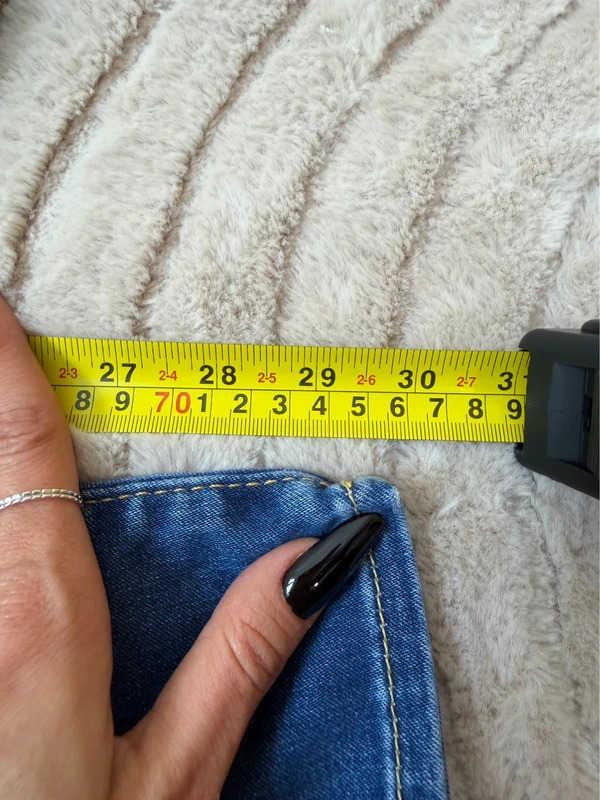
Put the end of the tape on one corner of the waistband and run it straight along the top edge to the other corner.
Stay on the top edge.
A low-rise waistband curves, and a tape that drifts down towards the pockets reads bigger.
That is the flat waist. Double it and you have the waistband all the way round, which is what a W number claims to be.
On my pairs the flat waist runs from 12 to 18½ inches. The biggest cluster sits at 14 or 14½.
So 28 or 29 inches round, on the hips.
Every listing here gives the flat figure. Waist 14″ means 28 round. The label maths, W by W, is in the W28 guide, and the short version is that the tape almost never comes in under the label.
Rise: waistband to crotch seam, down the front

Start at the top edge of the waistband, right by the button, and run the tape down the fly to the point where the leg seams and the crotch seam meet. That is the front rise.
The back rise is longer. Listings here give the front.
This is the number the label never prints, and it decides where the waistband lands on you.
The rail runs from 6 inches to 12½. Twenty-one pairs sit under 8, twenty-four between 8 and 9½, sixteen at 10 or over.
Under 8 sits well below the belly button on me. At 9 the waistband reaches my hip bone. Will it fit? files under 8½ as low and over 10½ as high, and the low-rise flare guide has 38 pairs measured at the low end.
My older listings call this the same thing in more words: waist to crotch seam.
Inside leg: crotch seam to hem
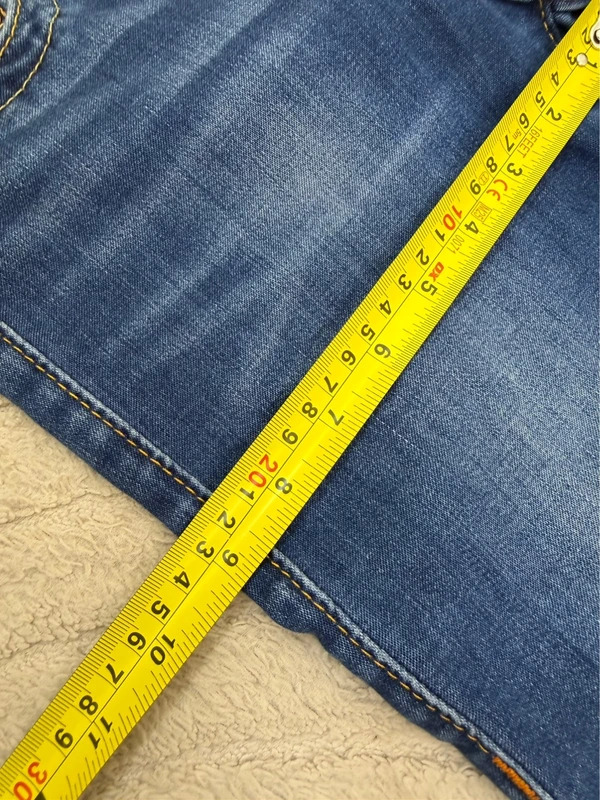
Straighten one leg, put the tape on the crotch point and run it down the inside seam to the bottom edge of the hem.
That is the inside leg: the L on a label, the inseam in American, the pant length or trouser length on some size charts.
The outside seam is a different number and includes the rise. Ignore it.
On the rail: 25 to 34 inches, and nearly half of the pairs land at 30 or 31.
Look inside the hem while you are there.
A fold line above the stitching, or thread that does not match the rest of the pair, means somebody has taken them up. Five pairs here say so on the listing.
Thigh and hem, the two nobody prints
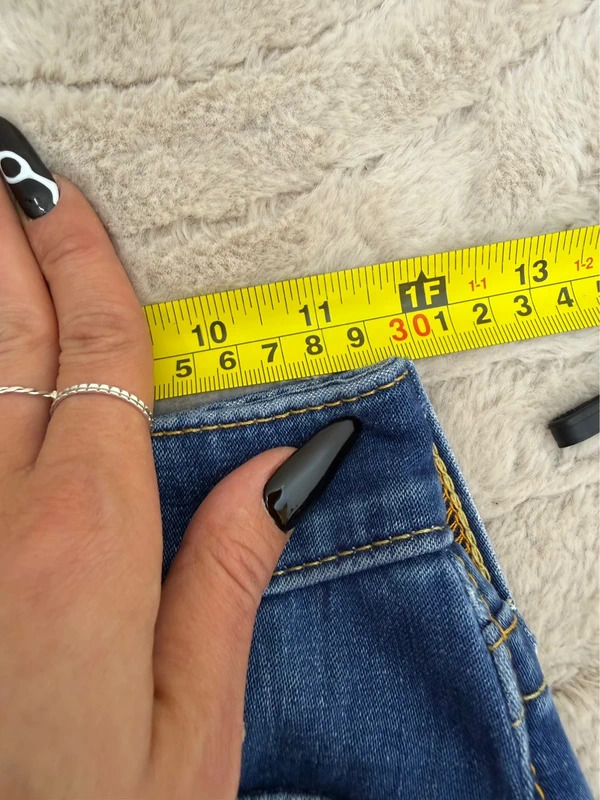
Thigh: straight across one leg, an inch below the crotch seam, flat. Mine run from 9 to 13 inches, most between 10 and 11½.
Hem: straight across the bottom edge of one leg, flat. This is the number that tells a bootcut from a flare when the photo will not.
Skinny pairs here measure 4 to 6 inches flat. Bootcuts 6 to 10½, most at 9. Flares 7 to 14, and the 14 is a customised Galliano.
Double every one of those for the opening.
The five numbers, from 62 pairs
| Number | Where the tape goes | Flat or round | On my 62 pairs |
|---|---|---|---|
| Waist | Across the top edge of the waistband, buttoned | Flat, then doubled | 12–18½″ flat, biggest cluster at 14–14½″ |
| Rise | Top of the waistband down the fly to the crotch seam | One number, front only | 6–12½″, most between 7 and 9 |
| Inside leg | Crotch seam down the inside seam to the hem | One number | 25–34″, most at 30–31 |
| Thigh | Across one leg, an inch below the crotch seam | Flat | 9–13″, most at 10–11½ |
| Hem | Across the bottom edge of one leg | Flat, then doubled | Skinny 4–6″, bootcut 6–10½″, flare 7–14″ |
62 pairs of jeans, measured flat in inches before listing. Shorts and skirts get the same treatment and are not in these figures.
When the label and the tape disagree
They disagree on most Y2K pairs, and it is not because the labels are wrong. The two numbers are not describing the same place on you.
The W on a label is a nominal size, named for the natural waist of the body the jeans were cut for, not a tape measurement. My tape measures the waistband, and the waistband sits where the rise puts it.
On a high rise those are the same spot, so the two numbers land on top of each other. On a 7-inch rise the waistband sits three or four inches lower, across the hip bones, and every body is wider down there than at the waist. The jeans were cut for the place they land. So the waistband measures over the number on the label, and the lower the rise, the further over it goes. That is the whole Y2K gap, in one sentence.
| Rise | Pairs with a waist printed on the label | What the tape did |
|---|---|---|
| 8½″ and under | 33 | 29 read over the label, by 2″ at the median and 6″ at the worst. Three matched. One came in under. |
| 9–10″ | 11 | 6 over, 5 exact |
| 10½″ and up | 7 | 5 exact, 2 an inch over |
The Joe’s Jeans bootcut is the far end of it. Label W27, waistband 33 round, on a 7½-inch rise. Six inches of daylight, and the pair fits a UK 10 perfectly well. The Miss Sixty lace-up flares say 28 and measure 32 on a 6-inch rise. True Religion Joey, labelled W23, measures 26. Not one of those labels is lying. They are all naming a waist, and the jeans are nowhere near one.
Raise the rise and the gap closes. The Calvin Klein boyfriend pair has an 11½-inch rise and measures its W27 exactly. Cache Cache, 10½ inches, exactly its W26. High-waisted jeans sit where the label is looking, so the label and the tape finally agree.
One thing about my own titles, since it bears on the figures above. A lot of vintage denim prints no waist at all, only a US junior 5/6 or 7/8, or a French 36. When that happens the W in my title is my own doubled waistband figure rather than a label, and it will always match the measurements for the simple reason that it came from them. Those pairs are left out of the table. Only pairs with a waist actually printed on the label are counted.

Which brings me to the one that goes the other way. The Roberto Cavalli leopard pair says W 29 on the label and measures 27 round at a 7½-inch rise, which is the opposite of everything above. It is a slim stretch cut, 98 per cent cotton and 2 per cent Lycra, made to be pulled on and to give an inch back once it is on. It fits a UK 8 on me at 27. Stretch is the other thing the tape cannot see, which is why I say how much give a pair has in every listing.
The leg is a simpler story. Six pairs here carry an L the tape disagrees with, all six shorter than they say by 1 to 2 inches, and none longer. The Drykorn says 32 on both lines of its label and measures 30½ on the leg. A Silver W26 says L33 and measures 31. A Miss Me W25 says 33½ and measures 32.
Nobody sews a label two inches wrong.
Somebody took them up, or the denim shrank over twenty years of washing, and the label stayed put. Either way the label is history and the tape is now.
How long is long: the inside leg on a 5 foot 6 frame
A leg length only means something against a height and a shoe. Mine is 5 foot 6, and the pairs on the rail have sorted themselves out like this.
| Inside leg | On me, 5 foot 6 | Pairs that showed it |
|---|---|---|
| 25″ | Mid-calf. A capri, on purpose. | Bianca capri, 25″ on an 11-inch rise |
| 27–27½″ | Ankle length. Petite, or taken up. | Telepatía 27″, listed for petite frames; FIRS 27″; Miss Sixty 27½″, shortened for my height ages ago |
| 29–31″ | Full length on me. Where most pairs land. | True Religion Julie 29½″; Joe’s W26 30½″, shortened for my height; Rock Revival 30½″ |
| 32–32½″ | Wants a heel. | Miss Me 32″ and 32½″; Cavalli 32″ |
| 33–34″ | A heel and a bit of drag on the floor, or a taller frame. | Big Star 34″; Royalty 33″; True Religion Billy 33″ |
Two pairs on that table were taken up for the same height and came out three inches apart.
One was done ages ago. That is how much shoes change the answer.
So take the pair you already wear at the length you like, lay it flat, and measure the inside leg once. That figure travels to every listing here.
Or read it off the photos. Every pair shown on me is on a 5 foot 6 frame, so the picture already tells you where 30½ inches ends.
Measuring yourself to match
Two numbers of your own. Where the waistband will sit, and your hips at the widest point.
For a rise under 8, measure round yourself at hip-bone height. For a rise of 10 or more, at the navel. Hold that against the doubled waist in the listing, and give a rigid pair an inch of room. Twenty-nine of my 62 pairs have no stretch at all.
Or put your usual size into Will it fit? once and let every pair on the site do the sums, low-rise allowance included. The size guide has the conversion tables for when a label says 38 or 13 instead of a W.
Questions people ask
What is the difference between inseam and outseam?
The inseam runs along the inside of the leg, from the crotch seam to the hem, and is the L on a label. The outseam runs down the outside of the leg from the top of the waistband to the hem, so it includes the rise. Two pairs with the same inseam can have outseams three inches apart.
How do I measure pant length (inside leg)?
Straighten one leg, put the tape on the crotch point and run it down the inside seam to the bottom edge of the hem; that number is the inside leg, the L on a label.
How do I measure jeans without a tape measure?
A sheet of A4 paper is 8¼ by 11¾ inches. Lay the short edge along the waistband, mark where it ends and move it along; two short edges and a bit is a 17-inch flat waist. For the inside leg, a length of string and any ruler afterwards.
Why is the back rise longer than the front?
Because it has to go over your bottom. The back rise on any pair is a few inches longer than the front, and the gap widens on a low rise, which is cut to sit flat at the front and still cover you at the back. Listings here give the front rise only, measured down the fly.
Every pair on the jeans rail carries all five numbers on the listing, and the wider legs are on the flare rail. Stuck between two pairs? Message me on WhatsApp from the product page and the tape comes out again.
Compare labels side by side: Jeans sizing by brand, one row per label, from every pair we have measured.