Italian, French and German Sizes to UK: 32 Vintage Labels Against the Tape

UK delivery from this site · prices in GBP · Outside the UK? Find our pieces on eBay and Vestiaire Collective, which ship internationally.
I grew up in Romania, where a dress label reads 36, 38 or 40 and nobody thinks twice about it. Then I moved to England and started selling vintage to people who think in 8, 10 and 12.
In Europe, a 36 is usually an S, a 38 an M and a 40 an L. In England an M tends to mean a UK 12 to 14, which is more like a 40 or 42 on a continental label. Same letter, two sizes apart.
A lot of the pieces on my rail come from Italy, France or Germany, so I convert those numbers every week. I try every piece on and measure it before it goes online, and over time I noticed the label and the tape do not always agree. This guide is what I have learned from that: the simple sums that work most of the time, and the pieces where they did not.
Take the Italian number and subtract 32. Take a French number and subtract 28, a German one and subtract 26. So IT 40 is a UK 8, FR 38 is a UK 10, DE 38 is a UK 12.
That arithmetic held on 25 of the 32 continental-labelled pieces I have measured and listed since August.
The seven it missed are the useful part, and they are further down.
The sums, straight from a brand’s own chart
I did not want to give you my sums without a source, so here is a Paris label’s own conversion. This is the women’s ready-to-wear row from Sandro’s size guide, copied as printed.
| UK / Ireland | French | German | Italian | Bust (cm) | Waist (cm) |
|---|---|---|---|---|---|
| 6 | 34 | 32 | 38 | 80–84 | 62–66 |
| 8 | 36 | 34 | 40 | 84–88 | 66–70 |
| 10 | 38 | 36 | 42 | 88–92 | 70–74 |
| 12 | 40 | 38 | 44 | 92–96 | 74–78 |
| 14 | 42 | 40 | 46 | 96–100 | 78–82 |
Each column climbs in steps of two. That is why a single subtraction works for the whole row.
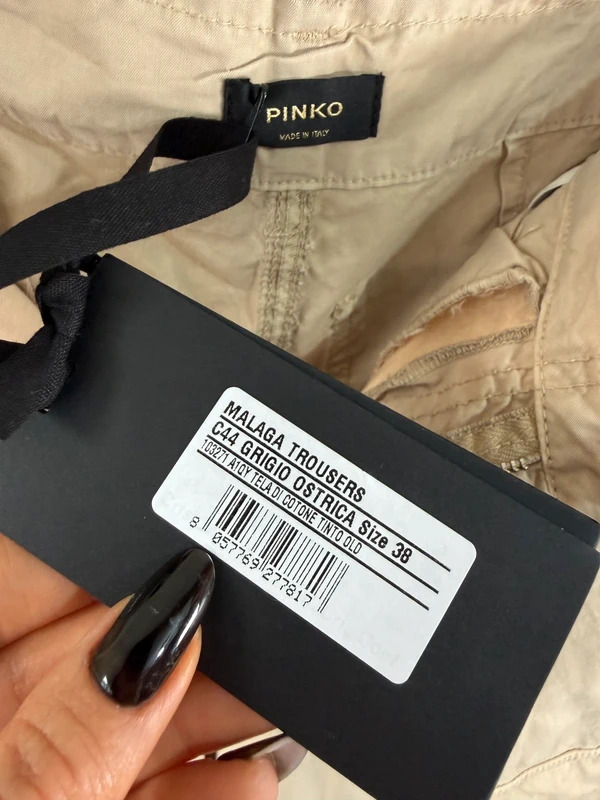
An Italian label agrees. The Pinko cargo trousers on my rail came with their care label still crisp. It prints its own little conversion grid.
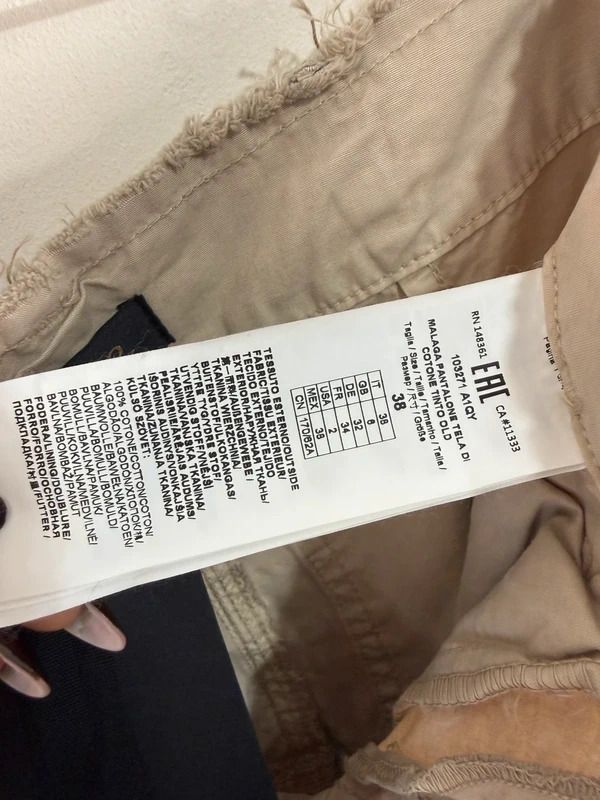
IT 38, GB 6, DE 32, FR 34. Subtract 32, 26 and 28, and every column lands on 6.


So the arithmetic is sound. The trouble starts when you put a tape measure on the actual trousers.
Thirty-two labels against the tape
Below is every garment with an IT, FR, DE or EU number that has come through here. Shoes and the one men’s jacket are left out, and they get their own sections later.
“Sum says” is the subtraction above. “Fits” is the UK size I listed after trying the piece on a UK 8 frame and measuring it flat. Tape figures are doubled to give the full way round.
| Label | Piece | Sum says UK | Fits UK | Tape |
|---|---|---|---|---|
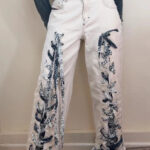
| IT 38 | Pinko cargo trousers, new with tags | 6 | 8–10 | waist 29″ |
| IT 38 | Valentini Roma trousers (gone) | 6 | 6–8 | waist 26″ |
| IT 40 | Dolce & Gabbana knit top | 8 | 8 | bust 35″, stretch |
| IT 40 | Gianfranco Ferré silk batwing blouse | 8 | 8–10 | oversized cut |
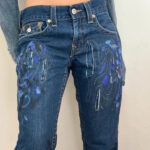
| 26 / IT 40 | Dolce & Gabbana custom denim mini | 8 | 8 | waist 29″ |
| IT 40 | McQ custom denim mini (gone) | 8 | 8–10 | waist 30″ |
| IT 42 | Just Cavalli mini dress | 10 | 10 | bust 38″ |
| 28 / IT 42 | D&G corduroy jacket (gone) | 10 | 10 | bust 38″ |
| IT 42 | D&G Year of the Pig T-shirt | 10 | 12–14 fitted | bust 38″, stretch |
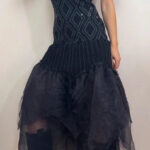
| 32 / 46 | D&G black midi dress | 14 | 12–14 | bust 34″ relaxed, stretch |
| IT 46 / 30″ | Vagabond pleated jeans (gone) | 14 | 8–10 | waist 30″ |
| FR 36 | Isabel Marant suede mini | 8 | 8 | waist 25″ |
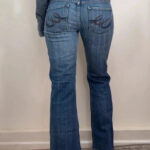
| EU 36 | Kookaï low-rise flares | 8 | 8 | waist 29″ |
| EU 36 | & Other Stories wool jacket (gone) | 8 | 8–10 | bust 38″, boxy |
| EU 36 | COS sheer blouse (gone) | 8 | 8–10 | oversized cut |
| FR 38 | Chloé silk slip dress | 10 | 8–10 | bust 36″ |
| EU 38 | Balenciaga 2009 printed dress | 10 | 8–10 | bust 33″, draped |
| EU 36 | Love Moschino cargo mini | 8 | 8–10 | waist 29″ |
| EU 36 | Carlo Colucci wrap cardigan | 8 | 8–10 | bust 34″ |
| EU 36 | Frankenwälder maxi skirt (gone) | 8 | 6–8 | waist 24″ |
| EU 38 | Bianca capri jeans | 10 | 8–10 | waist 27″ |
| EU 38 + UK 12 | Comma knit top (gone) | 10 | 10 | bust 30″, stretch |
| EU 38 | Repeat cashmere cardigan (gone) | 10 | 8–10 | bust 36″ |
| EU 38 | ASOS metallic cami (gone) | 10 | 10 | bust 30″ |
| EU 38 | H&M paperbag shorts (gone) | 10 | 10 | waist 31″, elastic |
| EU 40 | Jette Joop cashmere cardigan | 12 | 10–12 | bust 34″ |
| EU 40 | Lucia wool blazer | 12 | 12 | bust 42″ |
| EU 42 | InWear lace blouse | 14 | 14–16 | bust 39″ |
| EU 42 | Hanna Ecker polka-dot skirt (gone) | 14 | 10–12 | waist 31″ |
| EU 42 | Calw camel coat (gone) | 14 | 12 | bust 41″ |
| EU 46 | Colmar safari dress | 18 | 14 | bust 38″, waist 36″ |
| D 38 / UK 12 / F 40 | Louis Féraud velvet dress | 12 | 10 | bust 34″, waist 29″ |
For every EU label I used the French column. That is the scale the high street uses: the ASOS cami and the H&M shorts were both an EU 38 and a UK 10.
Italian labels: eight of eleven where the sum said.
French and EU labels: seventeen of twenty. German: none of one.
Where the sum went wrong
Seven pieces did not follow the sums. Here is what they taught me, in plain words.
Old labels often run small
Older pieces with big numbers, 42 and up, usually fit smaller than the sum says. A Hanna Ecker skirt labelled EU 42 should be a UK 14. Its waist is 31 inches, which is a UK 10 or 12.
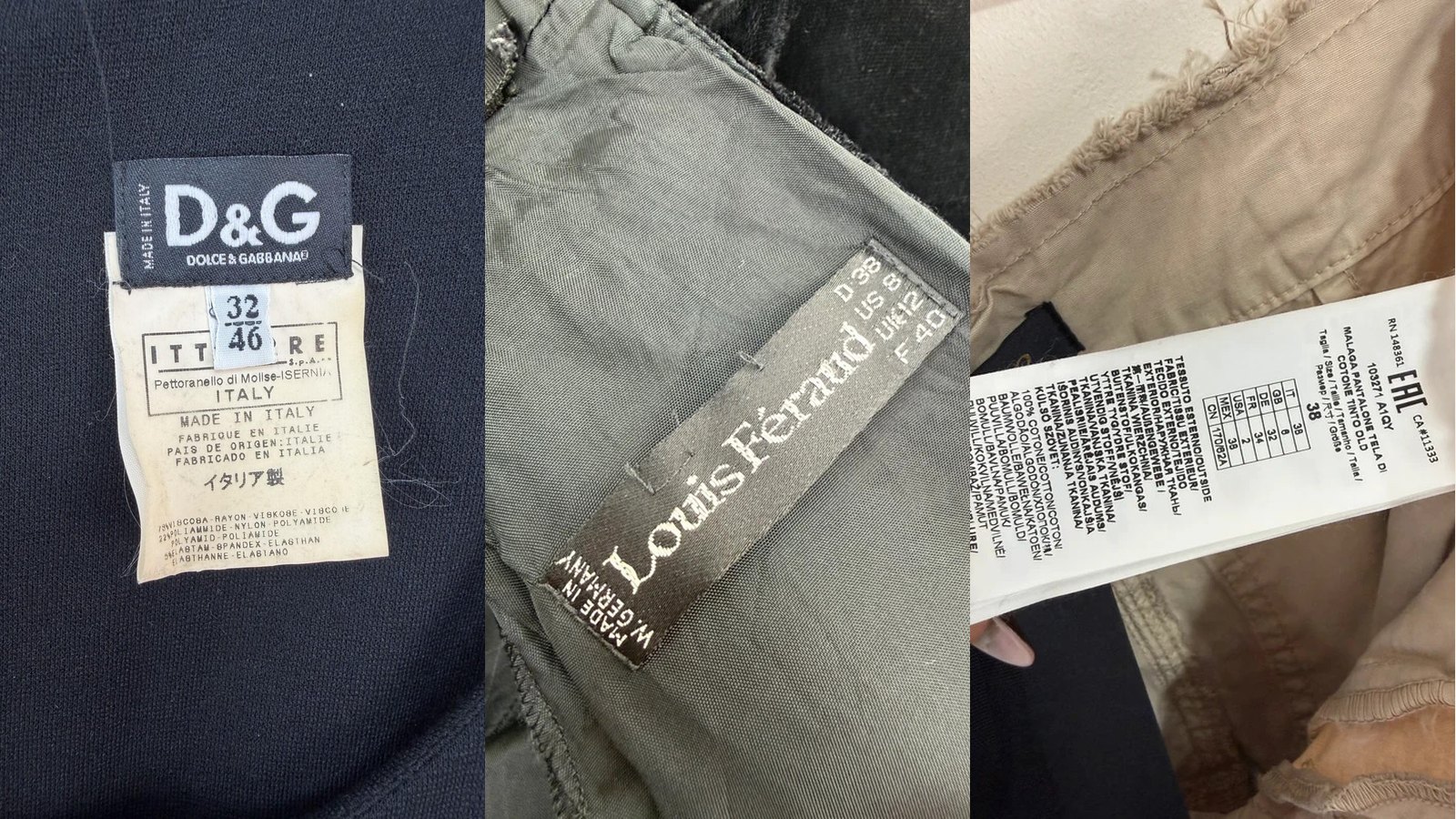
The Louis Féraud velvet dress is my favourite example. The label even does the conversion for you: D 38, UK 12, F 40. But the dress measures 34 inches at the bust, which is a UK 10. It was made in West Germany, before 1990, when sizes were cut smaller.

“EU” can mean different things
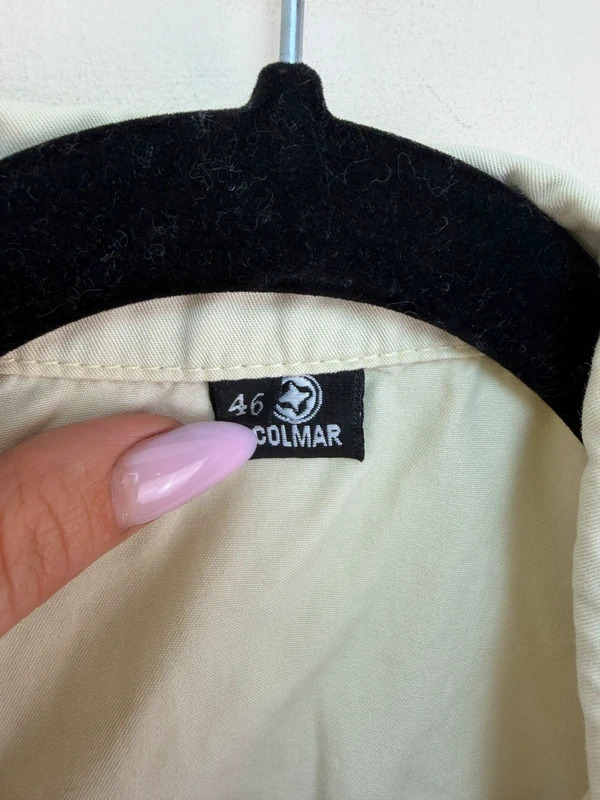
Some labels just say “EU” and do not tell you which country’s scale they use. A Colmar dress marked EU 46 only fits if you read it the Italian way, as a UK 14. A Love Moschino cargo mini marked EU 36 only fits if you read it the French way, as a UK 8. So when a label just says EU, trust the tape, not the number.
Some pieces run big
A few go the other way. Pinko trousers labelled IT 38 should be a UK 6, but they have a relaxed cut and fit a UK 8 to 10. The Dolce & Gabbana pig T-shirt is an IT 42, cut slim in stretch cotton, and a UK 12 or 14 can wear it fitted.

The lesson: use the sum as a starting point, then always check the measurements in the listing.
Dolce & Gabbana stacks two numbers
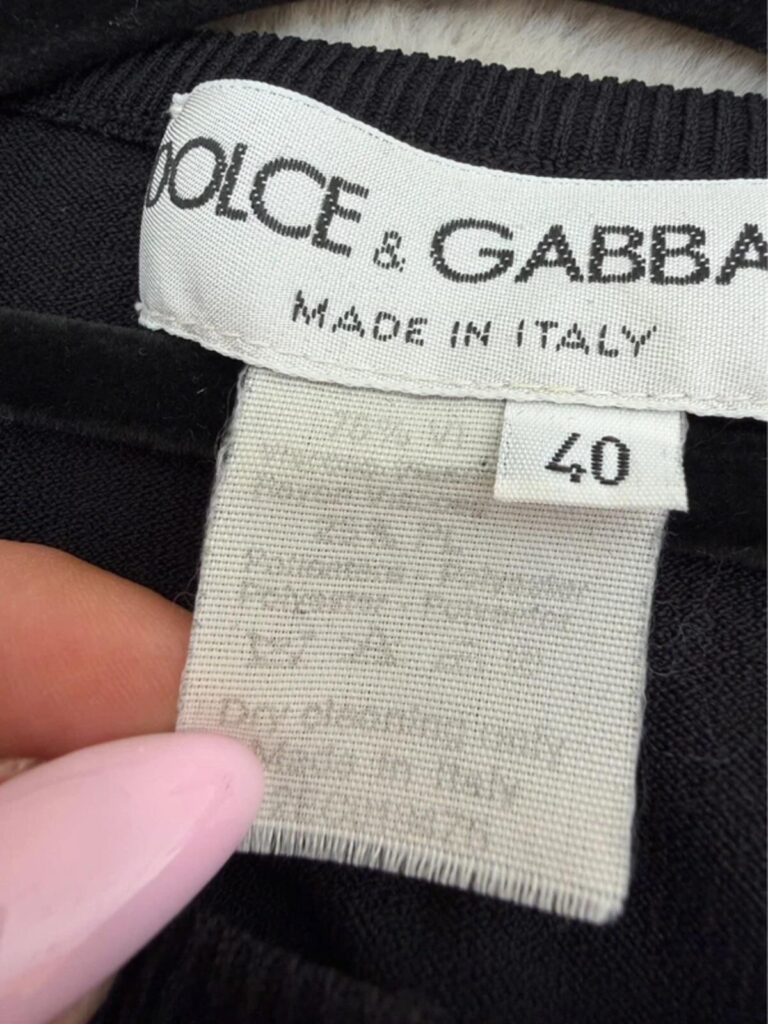
Three of the D&G pieces carry a small woven tab with two figures, one above the other.

26 over 40 on the denim mini. 28 over 42 on the corduroy jacket. 32 over 46 on the black fishtail midi.
The bottom number is the Italian size, and the sum works on it. The top one rises with it in step, fourteen lower every time, like a jeans waist.
It is not a measurement, though. The denim mini, the one with a waistband, says 26 and measures 29 inches round.



So read the lower number and leave the upper one alone. There are more pieces on the Dolce & Gabbana page.
Men’s and shoes run on different scales
Sandro’s chart has a men’s row too, and it starts somewhere else entirely.
A men’s suit jacket 46 is a UK 36 chest. A 54 is a UK 44.
The one men’s piece in my data is a brown 1980s leather bomber tagged EU 54.
Laid flat it is 25 inches across, so 50 round. Sold as a men’s XL to XXL, it is cut roomy, which fits the chart.
Shoes are another country again.
Five pairs through here were marked EU 38: Dr. Martens, Bertie, Replay, Tommy Hilfiger and Moda in Pelle. Four were a UK 5. The Moda in Pelle wedges were a UK 5½ to 6.
On Sandro’s shoe row, a standard 38 is also a UK 5, and their Italian shoe sizes sit one below the standard. Never carry a clothes conversion over to a shoe box.
What I check before trusting a continental label
Count the columns. If the label prints its own grid, use the grid and skip my sums.
Look for a country. Where the tag names one, as the Féraud does with D and F, use that country’s column.
Where it just says EU, try both the French and the Italian sums. See which one the tape agrees with.
Find the composition label. Elastane, Lycra or a rib knit will close the gap on a label that runs small.
That is how the IT 46 D&G dress works on a UK 8 pinned and a UK 14 unpinned.
Then believe the tape over everything.
Take a garment you already wear and like, lay it flat, and measure it the same way I do. The method is written up in how I measure jeans, and it works on skirts and trousers.
If you would rather not do sums at all, put your measurements into Will it fit? once. It compares them against the real measurements on every listing. The size guide has the UK-to-inches side of the conversion.
Knitwear is kinder to a wrong guess. The Joop cardigan in the table is one of the pieces in second-hand cashmere by brand and price.
For jeans specifically, the W-number problem has its own page: what a W28 really measures.
Questions people ask
Is EU 38 the same in clothes and shoes?
No. In clothes an EU 38 is usually a UK 10. In shoes it is a UK 5, and four of the five EU 38 pairs that have passed through here were exactly that.
Why is my Italian size two sizes off when I convert it?
Usually because the label said EU and you used the wrong column. Labels marked EU follow either the French or the Italian scale, so check the waist or bust in inches against the size guide before you trust the sum.
Do vintage continental labels run smaller than modern ones?
In the bigger sizes, on my rail, yes. Three of the four pieces labelled 42 or above on the EU scale measured at least a size smaller than the conversion said.
Most of these pieces live among the vintage dresses and the vintage designers, each with its tape measurements in the listing.